Artificial intelligence is moving beyond simple chatbots and question-and-answer systems. Modern AI applications can reason, use tools, interact with data, plan multiple steps, and perform tasks as part of larger workflows.
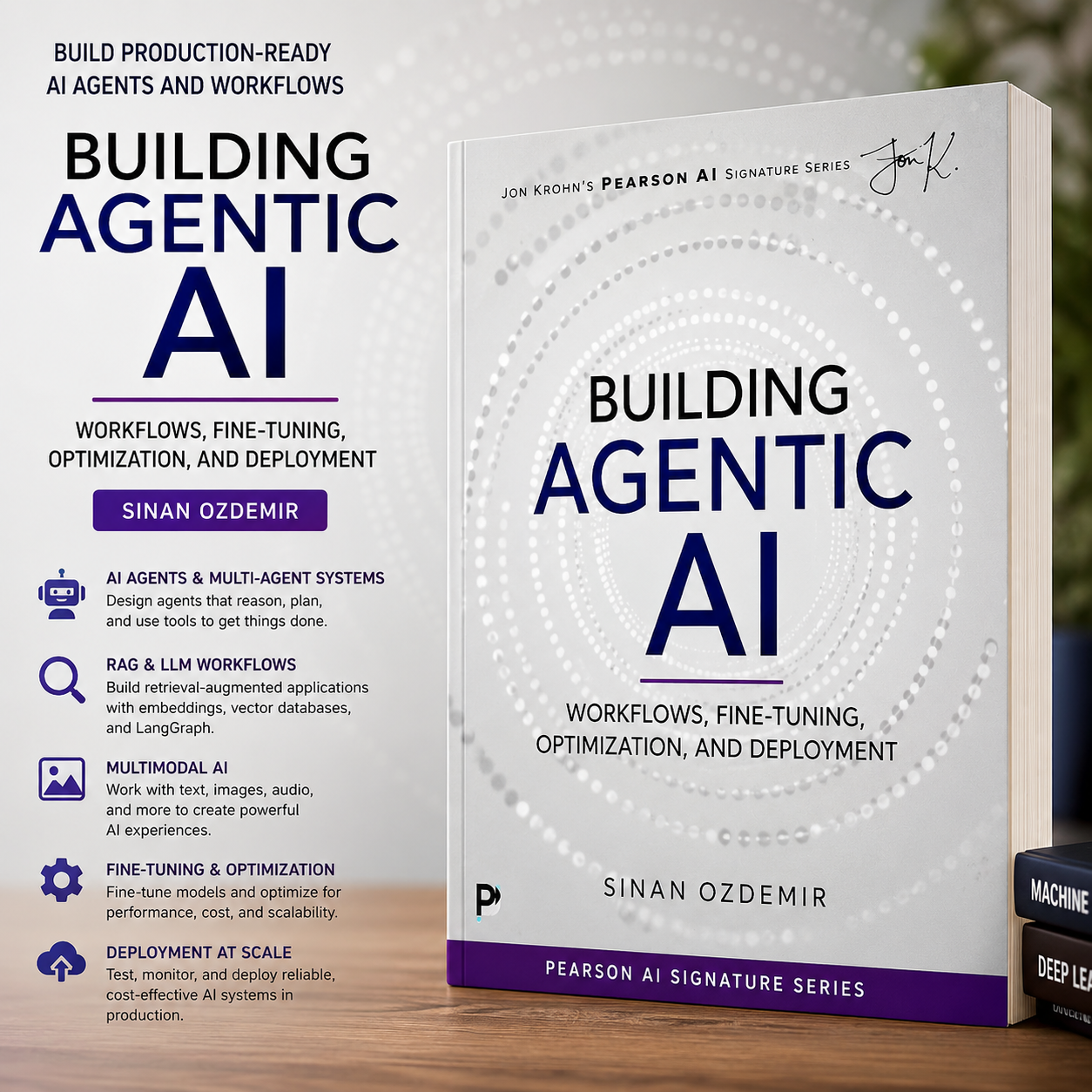
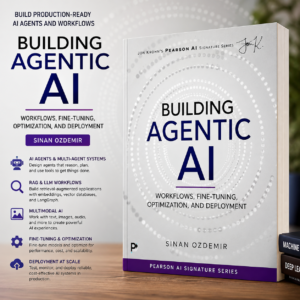
For developers, data scientists, product managers, and AI builders who want to understand how these systems are designed and deployed, Building Agentic AI: Workflows, Fine-Tuning, Optimization, and Deployment by Sinan Ozdemir provides a practical guide to building modern AI systems.
Published by Addison-Wesley Professional as part of the Pearson AI Signature Series, the book focuses on practical, production-oriented applications of AI rather than AI theory alone.
What Is Building Agentic AI About?
Building Agentic AI explores how developers and organizations can move beyond basic AI applications and build systems capable of responding, reasoning, planning, and executing tasks.
The book covers the complete agentic AI pipeline, from foundational concepts involving large language models and AI workflows to more advanced subjects such as AI agents, RAG, multimodal AI, fine-tuning, reasoning models, and production optimization.
Rather than presenting AI as a purely theoretical subject, the book uses practical examples and case studies to show how AI systems can be designed for real-world applications.
What Are AI Agents?
AI agents are designed to do more than simply generate a response.
An agent can combine a language model with instructions, tools, memory, and access to an external environment to accomplish more complex tasks.
The book introduces readers to AI agents and multi-agent workloads, including concepts such as tool use, memory, reasoning, and collaborative agent systems.
This makes the book particularly relevant as businesses increasingly explore AI systems that can perform multiple steps instead of simply answering individual questions.
Key Topics Covered in the Book
Building Agentic AI covers a broad range of technologies and techniques relevant to modern AI development.
LLM Workflows
The book begins with the foundations of large language models and explores how LLMs can be incorporated into practical workflows.
Readers can learn about LLM tasks, prompt engineering, alignment, AI workflows, and the fundamentals needed to build more capable AI applications.
AI Agents and Multi-Agent Systems
A major focus is the development of AI agents.
The book explores agent architectures, tool use, planning, memory, and multi-agent workloads. It also includes practical examples involving agents designed for more complex workflows.
Retrieval-Augmented Generation
The book covers RAG workflows, including embeddings, vector databases, and LangGraph state management.
These techniques can be useful when building AI applications that need to retrieve relevant information before generating an answer.
Multimodal AI
Modern AI is no longer limited to text.
The book also explores multimodal systems that can work with different types of data, including text, images, audio, and code generation.
Fine-Tuning AI Models
Fine-tuning is another important part of the book.
Readers can explore techniques for adapting AI models to specific tasks and improving their performance for particular applications. The book includes practical examples involving domain adaptation and calibrated performance.
AI Model Optimization
Building an AI system is only one part of the challenge.
Organizations also need to consider speed, cost, reliability, and scalability.
The book discusses production optimization techniques including model compression, speculative decoding, and other approaches for improving AI performance in real-world environments.
Building Production-Ready AI Systems
One of the strongest aspects of this book is its focus on production-ready AI.
A prototype may work well in a development environment, but deploying an AI system at scale introduces additional challenges.
Developers need to think about:
Accuracy
Latency
Cost
Reliability
Security
Privacy
Evaluation
Scalability
Model performance
The book addresses these practical considerations and provides frameworks for testing, monitoring, and optimizing agentic AI systems.
Who Should Read Building Agentic AI?
This book is particularly suited to readers with some existing technical knowledge.
It may be useful for:
AI developers
Software developers
Machine learning engineers
Data scientists
AI engineers
Product managers
Technical founders
Researchers
Developers working with LLMs
Professionals building AI-powered products
The publisher describes the book as relevant to developers deploying models, data scientists working with embeddings and agents, and product managers exploring AI workflows.
Is This Book Suitable for Beginners?
Not necessarily.
Building Agentic AI is better suited to intermediate and advanced readers who already have some familiarity with artificial intelligence, programming, or large language models. O’Reilly lists the book at an intermediate-to-advanced level.
If you are completely new to AI, a beginner-focused AI or ChatGPT book may be a better starting point.
However, if you already understand the basics of LLMs and want to move into AI agents, RAG, multi-agent systems, fine-tuning, and deployment, this book is much more directly relevant.
Practical AI Applications
The book connects agentic AI with real-world business applications.
The publisher highlights areas including:
Customer support
Finance
Research
Sales automation
Security
Marketing
Business process automation
The emphasis is on using AI to solve practical problems rather than building systems simply for experimentation.
About the Author
Sinan Ozdemir is an AI expert, entrepreneur, author, and educator.
He has a master’s degree in pure mathematics from Johns Hopkins University and founded Kylie.ai. He has also worked as a lecturer in data science and has authored other books and educational materials covering artificial intelligence, machine learning, and large language models.
His background combines mathematics, AI development, entrepreneurship, and teaching, which is reflected in the practical approach of Building Agentic AI.
Book Details
Title:Building Agentic AI: Workflows, Fine-Tuning, Optimization, and Deployment Author: Sinan Ozdemir Publisher: Addison-Wesley Professional Series: Pearson AI Signature Series Edition: 1st Edition Publication: 2025 Language: English Length: 320 pages Level: Intermediate to Advanced ISBN-13: 9780135489680 Category: Computers → Artificial Intelligence → Machine Learning & Deep Learning
Where to Buy Building Agentic AI
If you are interested in learning how to build AI agents, LLM workflows, RAG systems, and production-ready AI applications, you can check the current Amazon listing here:
AI agents represent an important step beyond traditional chatbot applications.
Instead of simply generating text, agentic AI systems can combine language models with tools, memory, planning, data retrieval, and multiple specialized agents to accomplish more complex tasks.
Building Agentic AI by Sinan Ozdemir is aimed at readers who want to understand how these systems are actually built, tested, optimized, and deployed.
With coverage of LLMs, AI agents, RAG, multimodal AI, fine-tuning, reasoning models, multi-agent systems, and production optimization, the book provides a broad technical foundation for developers and AI professionals who want to move beyond basic generative AI experiments.
SEO Keywords
Building Agentic AI, Building Agentic AI Sinan Ozdemir, Sinan Ozdemir AI book, AI agent book, agentic AI book, AI agents, AI agent development, LLM workflows, RAG AI, retrieval augmented generation, multi-agent systems, AI fine-tuning, AI model optimization, multimodal AI, reasoning LLMs, AI deployment, production AI, enterprise AI, machine learning books, artificial intelligence books.

 Artificial intelligence is moving beyond simple chatbots and question-and-answer systems. Modern AI applications can reason, use tools, interact with data, plan multiple steps, and perform tasks as part of larger workflows.