 Artificial intelligence is changing the way people communicate, work, access information, and interact with technology.
As AI systems become increasingly capable, questions about the future are becoming more difficult to ignore.
Will artificial intelligence change what it means to be human?
Could advanced technology influence our understanding of intelligence, consciousness, and morality?
How should society think about AI regulation, surveillance, automation, and human enhancement?
And perhaps one of the biggest questions: what happens when technological progress moves faster than our ability to understand its consequences?
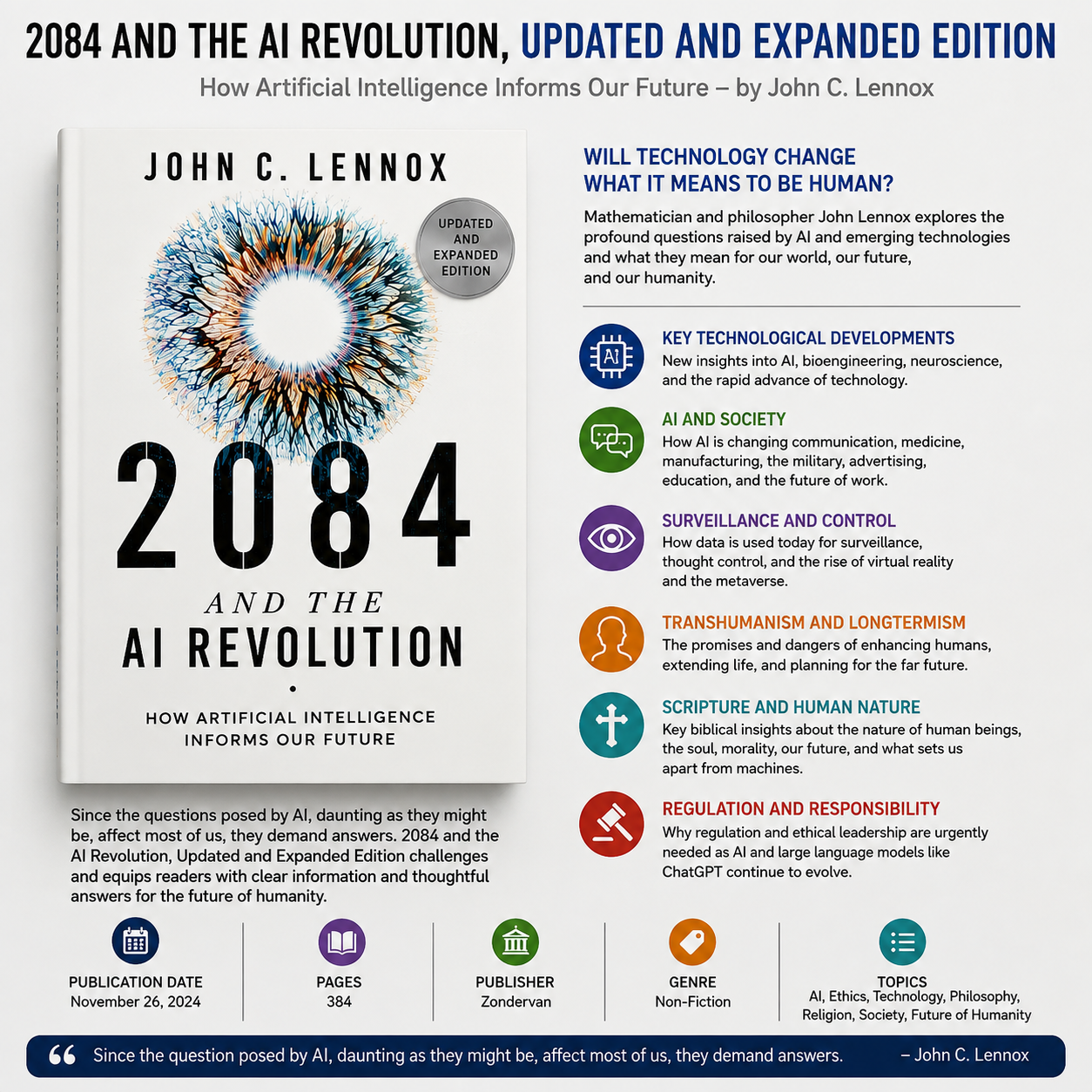
These are some of the questions explored in 2084 and the AI Revolution: How Artificial Intelligence Informs Our Future by mathematician and philosopher John C. Lennox.
The updated and expanded edition examines artificial intelligence from technological, philosophical, ethical, and Christian perspectives. The publisher describes the book as an accessible discussion of AI, technological enhancement, bioengineering, surveillance, transhumanism, and questions about humanity’s future.
What Is 2084 and the AI Revolution About?
2084 and the AI Revolution is not a programming textbook.
Instead, it is a broad exploration of the questions raised by artificial intelligence and rapidly developing technology.
John Lennox examines AI alongside subjects such as:
- Artificial intelligence
- Machine learning
- Neuroscience
- Human-computer interaction
- AI ethics
- Surveillance and big data
- Virtual reality
- The metaverse
- Transhumanism
- Longtermism
- AI regulation
- The future of work
- Human identity
- Morality
- Consciousness
- Science and religion
The updated edition also discusses large language models such as ChatGPT and the implications of increasingly capable AI systems.
Why the Title “2084”?
The title naturally invites comparison with George Orwell’s famous novel 1984.
Orwell’s novel explored themes such as surveillance, control, information, and government power.
Lennox uses the idea of 2084 to ask what a future shaped by advanced technology might look like.
The comparison is not simply about predicting a particular future.
Instead, it provides a framework for discussing questions surrounding technological development, surveillance, human enhancement, and the increasing role of artificial intelligence in society.
Artificial Intelligence and the Future of Humanity
One of the central questions in the book is whether technology could eventually change our understanding of what it means to be human.
Modern AI can already perform tasks that once appeared to require uniquely human abilities, including generating text, analyzing information, recognizing patterns, and interacting through natural language.
But capability is not necessarily the same thing as consciousness or human understanding.
This distinction leads to important philosophical questions.
For example:
- What is intelligence?
- What makes human intelligence different?
- Can a machine genuinely understand?
- Can technology reproduce human consciousness?
- What makes a person unique?
- Does greater computational ability mean greater intelligence?
These questions extend beyond computer science and enter the fields of philosophy, ethics, neuroscience, and theology.
AI and Human Identity
Technology has always influenced how people understand themselves.
From the invention of the printing press to computers and the internet, technological developments have changed communication and social structures.
Artificial intelligence introduces another layer.
AI systems can now generate language, create images, analyze data, and interact with users.
This raises questions about where the boundaries between human abilities and machine capabilities should be drawn.
2084 and the AI Revolution approaches these questions partly through the author’s Christian worldview, including discussion of human beings, the soul, morality, and what distinguishes humans from machines.
AI and Neuroscience
Understanding artificial intelligence also raises questions about the human brain.
The book discusses the nature of AI systems alongside insights from neuroscience.
This comparison can help readers think about the difference between:
Artificial systems
and
Biological intelligence.
A computer can process enormous quantities of information, but that does not automatically answer questions about consciousness, subjective experience, emotion, or moral responsibility.
These distinctions are important when discussing whether increasingly sophisticated machines should be understood as equivalent to human beings.
AI and the Future of Work
Artificial intelligence is already affecting workplaces.
Businesses can use AI for tasks involving:
- Writing
- Data analysis
- Research
- Customer service
- Automation
- Software development
- Communication
- Administrative work
The book considers how AI may influence the future of work and broader economic structures.
The important question is not simply whether AI will replace particular jobs.
It is also how human roles may change as certain tasks become increasingly automated.
Workers may need to develop new skills, while organizations may need to reconsider how responsibilities are divided between humans and AI systems.
AI in Medicine
Healthcare is another area where artificial intelligence is becoming increasingly relevant.
AI can potentially assist with tasks involving:
- Medical imaging
- Data analysis
- Research
- Administrative work
- Pattern recognition
- Clinical decision support
However, healthcare also demonstrates why human oversight remains important.
AI-generated recommendations need appropriate validation and professional interpretation.
A system producing a statistically plausible answer does not automatically mean that the answer is correct or appropriate for an individual patient.
The book considers the broader implications of AI across medicine and other industries.
AI, Manufacturing, and Transportation
Artificial intelligence is not limited to software.
AI technologies can also influence manufacturing, transportation, automobiles, and other physical systems.
Automation can allow machines to perform tasks that previously required direct human involvement.
This can potentially improve efficiency in some situations, but it also creates questions about safety, employment, responsibility, and regulation.
As autonomous systems become more sophisticated, society has to consider who is responsible when an automated system makes a mistake.
AI and Surveillance
One of the more serious topics discussed in 2084 and the AI Revolution is surveillance.
Modern societies generate enormous amounts of digital data.
This information can come from:
- Smartphones
- Cameras
- Websites
- Online purchases
- Social media
- Search activity
- Connected devices
- Location-enabled services
AI can potentially make it easier to process and analyze large datasets.
That creates legitimate questions about privacy.
Who has access to the data?
How is it being used?
How long is it stored?
Can individuals understand how their information is being analyzed?
These questions become increasingly important as AI becomes better at identifying patterns in large datasets.
Big Data and Social Control
The book connects surveillance with broader questions about information and social control.
This is a subject that deserves careful consideration because data itself is not necessarily harmful.
Data can be used for legitimate purposes such as improving services, conducting research, or detecting fraud.
The concern arises when information is collected or used without appropriate transparency, safeguards, or accountability.
AI can potentially make large-scale data analysis more powerful, which increases the importance of responsible governance.
Artificial Intelligence and Regulation
As AI systems become more capable, governments and organizations are considering how they should be regulated.
The book argues for the importance of regulation and control in light of developments such as large language models.
This is not simply a technical issue.
AI regulation can involve questions about:
- Privacy
- Safety
- Accountability
- Copyright
- Employment
- Security
- Transparency
- Bias
- Human oversight
Different countries and institutions may approach these issues differently.
The book encourages readers to think about the broader consequences of AI rather than viewing technological development as something that should happen without limits.
AI, Virtual Reality, and the Metaverse
Another subject explored in the book is the rise of virtual reality and the metaverse.
Digital environments can increasingly provide experiences that feel more immersive.
This creates interesting questions about how people divide their time between physical and digital environments.
For example:
- How much of social interaction should happen digitally?
- Could virtual environments change relationships?
- What happens when digital experiences become increasingly realistic?
- How should identity work in virtual spaces?
These questions become even more interesting when combined with AI systems capable of generating realistic language, images, and virtual experiences.
Transhumanism and Human Enhancement
The book also discusses transhumanism.
Broadly speaking, transhumanism involves ideas about using technology to enhance or transform human capabilities.
Potential areas of discussion include:
- Biotechnology
- Brain-computer interfaces
- Genetic technologies
- Artificial intelligence
- Human augmentation
- Longevity
These developments raise philosophical and ethical questions.
If technology allows people to significantly enhance certain human abilities, where should society draw the line?
Who should have access to such technologies?
Could technological enhancement increase inequality?
And what does it mean to remain human in an age of increasingly sophisticated technology?
The book examines these questions from the author’s philosophical and Christian perspective.
AI and Longtermism
Another topic included in the updated edition is longtermism.
Longtermism is a philosophical approach that places significant importance on the effects of actions on future generations.
The subject has become increasingly relevant in discussions about advanced artificial intelligence.
Some AI researchers and philosophers are concerned about potential long-term consequences of highly capable AI systems.
Others focus more heavily on the immediate social and economic effects of existing AI technologies.
2084 and the AI Revolution introduces readers to these broader debates and places them within its discussion of humanity’s technological future.
AI: Facts, Fiction, Benefits, and Risks
A useful feature of the book is that it does not discuss AI exclusively in terms of either optimism or pessimism.
The publisher describes the book as an exploration of AI’s current capabilities, potential benefits and dangers, facts and fiction, and possible future implications.
That distinction matters.
Artificial intelligence is neither automatically beneficial nor automatically harmful.
The impact depends heavily on:
- How the technology is designed
- How it is deployed
- Who controls it
- What data it uses
- How people interact with it
- What regulations exist
- How organizations manage risks
A Christian Perspective on Artificial Intelligence
One of the characteristics that distinguishes this book from many general AI books is its Christian perspective.
John Lennox examines artificial intelligence not only through mathematics and science but also through philosophy and theology.
The book discusses subjects such as:
- Human nature
- The soul
- Morality
- Human purpose
- The distinction between humans and machines
- Scripture
- The future of humanity
The theological arguments are presented as the author’s perspective and should be understood in that context.
Readers from different religious or philosophical backgrounds may agree with some arguments, disagree with others, or simply find them useful as part of a broader discussion about technology.
The publisher specifically notes that the book is intended to challenge readers and encourage them to think about humanity’s future.
Is This a Technical AI Book?
No.
2084 and the AI Revolution is not a programming manual.
You do not need to know how to code AI systems to understand the book.
Instead, it is aimed at general readers who want to think about artificial intelligence from multiple perspectives.
The discussion combines:
Technology + Philosophy + Ethics + Science + Theology.
That makes it quite different from books focused exclusively on ChatGPT prompts, AI programming, or business automation.
Who Should Read 2084 and the AI Revolution?
The book may be particularly interesting for:
- Readers interested in artificial intelligence
- Technology enthusiasts
- Students
- Educators
- Business professionals
- Readers interested in AI ethics
- People interested in technology and society
- Readers interested in philosophy
- Readers interested in science and religion
- Christian readers interested in AI
- Readers curious about humanity’s technological future
It can also be useful for readers who want to understand AI debates without needing a computer-science background.
About John C. Lennox
John C. Lennox is a mathematician and philosopher whose work explores the relationship between science, philosophy, and theology.
According to Google Books and the publisher, Lennox is Professor of Mathematics Emeritus at the University of Oxford and an Emeritus Fellow in Mathematics and the Philosophy of Science at Green Templeton College, Oxford.
He has written several books dealing with questions at the intersection of science and religion.
His background is particularly relevant to 2084 and the AI Revolution, because the book attempts to connect technological developments with philosophical and theological questions.
Book Details
Title: 2084 and the AI Revolution: How Artificial Intelligence Informs Our Future
Author: John C. Lennox
Publisher: Zondervan
Updated & Expanded Edition: 2024
Publication Date: November 26, 2024
Language: English
Genre: Non-Fiction
Category: Artificial Intelligence / Technology & Society / Science & Religion / AI Ethics
Topics: Artificial Intelligence, AI Ethics, Surveillance, Big Data, Transhumanism, Longtermism, Virtual Reality, Metaverse, Human Identity, Technology and Religion
The updated hardcover edition is listed by Zondervan at 384 pages with ISBN 9780310166641. Google Books also lists a 384-page edition with ISBN 9780310166658, reflecting a different format/ISBN.
Where to Buy 2084 and the AI Revolution
If you are interested in exploring the book and want to check the current Amazon edition, format, and price, you can view the listing here:
👉 Check 2084 and the AI Revolution by John C. Lennox on Amazon
Affiliate disclosure: This article contains an affiliate link. If you make a purchase through the link, the publisher of this website may receive a commission at no additional cost to you.
Final Thoughts
Artificial intelligence is not only a technological subject.
It also raises questions about human identity, morality, privacy, employment, consciousness, responsibility, and the future of society.
2084 and the AI Revolution by John C. Lennox approaches these questions through a combination of technology, philosophy, science, ethics, and Christian theology.
The book is particularly interesting for readers who want to move beyond learning how to use AI tools and instead consider what increasingly powerful technology could mean for humanity.
It is not a technical AI manual, nor does it attempt to provide a simple answer to every question surrounding artificial intelligence.
Instead, it encourages readers to examine the technology, its potential benefits and risks, and the philosophical questions that accompany its development.
For readers searching for an AI ethics book, artificial intelligence and religion book, AI and Christianity book, AI and philosophy book, artificial intelligence and humanity book, technology and society book, AI future book, transhumanism book, or artificial intelligence ethics guide, 2084 and the AI Revolution offers a distinctive perspective.