 Artificial intelligence is changing how organizations think about technology, operations, and the future of work. For architecture, engineering, and construction companies, the conversation can be especially important because AI can influence everything from business processes and project delivery to organizational strategy.
But adopting AI is not simply a matter of purchasing new software.
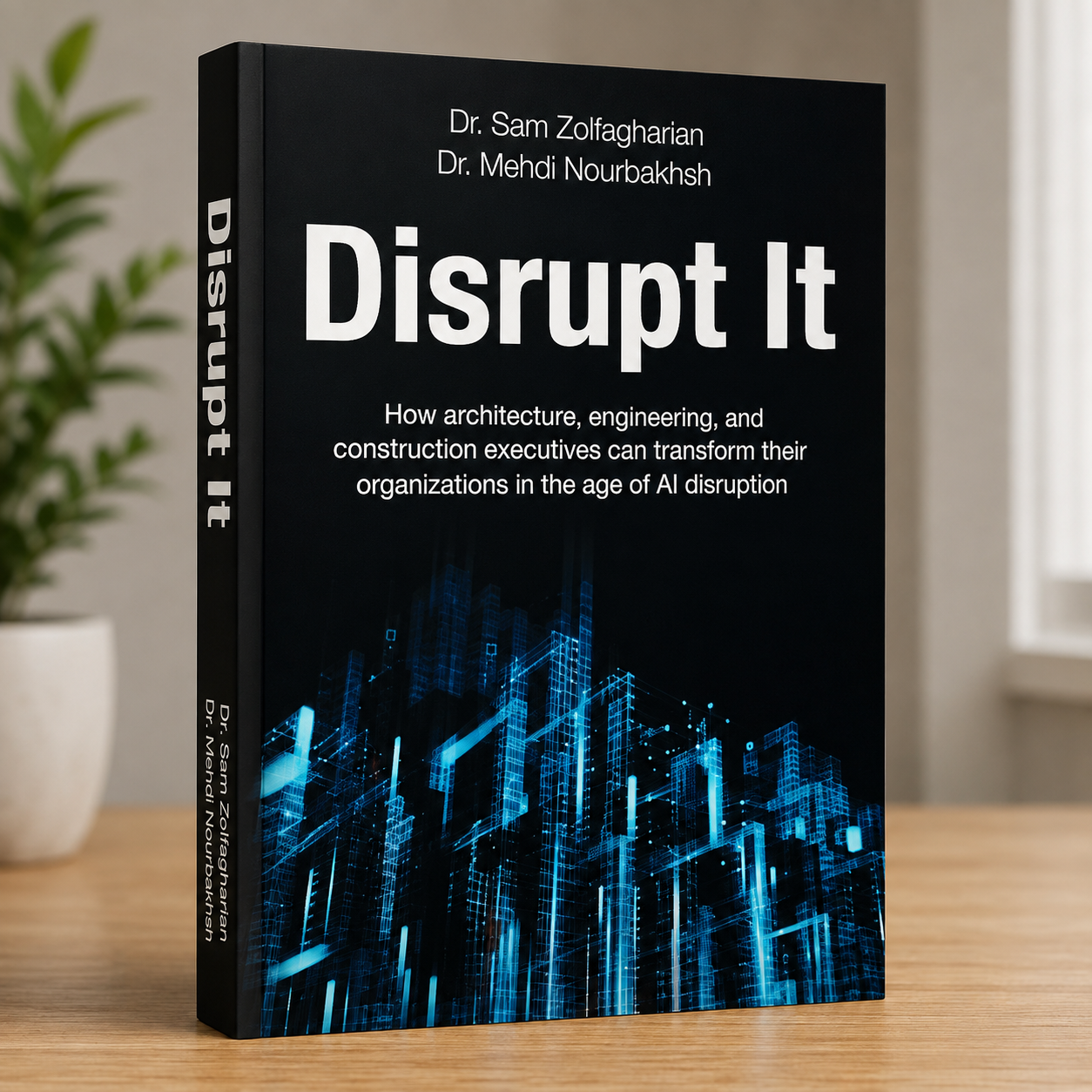
Disrupt It: How Architecture, Engineering, and Construction Executives Can Transform Their Organizations in the Age of AI Disruption by Dr. Sam Zolfagharian and Dr. Mehdi Nourbakhsh focuses specifically on how leaders in the architecture, engineering, and construction (AEC) industry can approach AI transformation.
The book was published in 2025 and is written for executives and business leaders who may not have extensive technical backgrounds.
What Is Disrupt It About?
Disrupt It is a business and leadership book about preparing AEC organizations for an environment increasingly influenced by artificial intelligence.
Rather than presenting AI as simply another technology upgrade, the authors frame AI adoption around three organizational areas:
- Culture
- Business model
- Operating model
The authors’ framework is intended to help organizations consider AI from a strategic perspective rather than treating it solely as an IT project.
This approach is particularly relevant to executives who need to think about how technology affects the broader organization.
AI and the Architecture, Engineering, and Construction Industry
The AEC industry has unique characteristics.
Projects often involve multiple teams, complex workflows, large amounts of information, specialized expertise, deadlines, and significant coordination between stakeholders.
Because of this complexity, introducing AI requires more than selecting an AI tool.
Leaders may need to consider:
- How employees will use the technology
- Which processes could benefit from AI
- How business models might change
- What information should be protected
- How AI decisions should be reviewed
- What skills employees need
- How new technology fits existing workflows
Disrupt It focuses specifically on these types of organizational questions.
The Three Pillars of AI Readiness
One of the central concepts presented by the authors is a three-pillar framework for AI readiness.
1. Culture as a Foundation
Technology adoption is influenced by organizational culture.
If employees are unfamiliar with AI or uncertain about how it affects their work, introducing new systems can create confusion or resistance.
The authors argue for building a culture that supports innovation and responsible experimentation.
This does not mean every employee needs to become an AI specialist.
Instead, organizations can focus on developing enough understanding and confidence for employees to identify appropriate opportunities for AI-assisted work.
2. Business Model as a Value Generator
AI can potentially change how companies create and deliver value.
For AEC executives, this raises questions such as:
- Could AI change existing services?
- Are there new opportunities created by AI?
- Which customer problems could be addressed differently?
- Could existing processes be redesigned?
- How might competitors use AI?
The book encourages leaders to consider AI in relation to their business model rather than viewing it only as an efficiency tool.
3. Operating Model as an Enabler
The third pillar focuses on how work actually gets done.
An organization may have a strong AI strategy, but the strategy still needs to connect with everyday operations.
This can involve reviewing:
- Processes
- Responsibilities
- Workflows
- Technology
- Decision-making
- Collaboration
- Performance measurement
The authors describe the operating model as an enabler for transforming organizations in an AI-driven environment.
Preparing an Organization for AI
One of the practical questions addressed by the book is how a company can prepare for AI adoption.
Instead of immediately implementing multiple AI systems, leadership teams can first examine their current organization.
A useful starting point is to ask:
Where are our biggest operational challenges?
Which activities involve repetitive information processing?
Where could better information access improve decision-making?
Which processes require significant manual effort?
What risks could AI introduce?
These questions can help organizations identify areas worth investigating before committing to a particular technology.
AI Adoption Is Not Only a Technology Project
A common assumption is that AI transformation is primarily about choosing the right software.
In practice, technology is only one part of organizational change.
Successful implementation can also depend on:
- Leadership
- Employee participation
- Training
- Process design
- Data quality
- Governance
- Communication
- Clear objectives
This is one of the reasons Disrupt It places culture, business models, and operating models at the center of its framework.
AI and Business Model Transformation
AI can potentially influence more than internal productivity.
It may also change how companies deliver services and interact with customers.
For example, an organization might explore whether AI can help it:
- Analyze information more efficiently
- Identify new service opportunities
- Improve internal coordination
- Support customer communication
- Develop new approaches to project delivery
These are possibilities rather than guaranteed outcomes. The appropriate use of AI depends on the organization’s circumstances, technology, data, regulations, and business objectives.
AI and Operational Efficiency
Operational efficiency is another important theme in AI discussions.
AI tools can potentially assist with certain information-heavy tasks, such as organizing information, generating drafts, summarizing documents, or identifying patterns in large datasets.
However, automation should not automatically be treated as a substitute for professional judgment.
In industries where safety, engineering decisions, contracts, regulations, and significant financial commitments are involved, human review remains important.
The authors’ framework therefore considers AI transformation at an organizational level rather than simply promoting automation for its own sake.
The Importance of AI Governance
Introducing AI into an organization also creates questions about governance.
For example:
- Who can use particular AI systems?
- What information can employees provide to AI tools?
- How should AI-generated information be reviewed?
- Who is responsible for important decisions?
- How should sensitive business information be protected?
- How should organizations evaluate AI systems?
These questions become increasingly relevant as AI moves from experimentation into everyday business processes.
A responsible AI strategy should consider not only potential benefits but also privacy, security, accuracy, accountability, and appropriate human oversight.
Case Studies and Examples
The book includes case studies and examples involving AEC organizations that have begun their AI transformation journeys.
These examples are intended to provide readers with practical context rather than presenting AI transformation as a purely theoretical exercise.
For executives, real-world examples can be useful because they demonstrate how broad AI concepts can relate to actual organizational decisions.
Who Is Disrupt It For?
The book is specifically aimed at professionals in the architecture, engineering, and construction industry.
Potential readers include:
- AEC executives
- CEOs
- Board members
- Business leaders
- Innovation leaders
- Technology decision-makers
- Architecture firm leaders
- Engineering firm leaders
- Construction executives
- Managers responsible for digital transformation
It can be particularly relevant to leaders who want to understand AI strategy without needing to become software engineers.
Is Disrupt It a Technical AI Book?
Not primarily.
The book is positioned as a strategic and organizational guide rather than a programming manual.
You will not need to learn Python or build a neural network to understand its main ideas.
Instead, the focus is on questions such as:
How should an organization prepare for AI?
How can leadership create an environment where AI adoption is practical?
How could AI influence a company’s business model?
How should operational processes evolve?
These questions make the book different from technical AI textbooks.
What Makes This Book Relevant to AEC Leaders?
A major strength of Disrupt It is its industry-specific focus.
Many AI books are written for a general technology audience.
This book, however, was specifically developed around the challenges faced by architecture, engineering, and construction executives.
That means readers in the AEC industry can approach the subject through a business context that is more closely related to their own environment.
About the Authors
Dr. Sam Zolfagharian
Dr. Sam Zolfagharian is an AI strategist, author, and co-founder and president of YegaTech.
Her work focuses on helping organizations understand AI’s impact on business, innovation, and organizational transformation. YegaTech describes her as working at the intersection of AI and the AEC industry.
Dr. Mehdi Nourbakhsh
Dr. Mehdi Nourbakhsh is an author, speaker, and CEO of YegaTech, an AI and technology consulting company focused on the AEC industry.
His background includes structural engineering, computer science, AI research, and work related to technology and design.
Together, the authors bring experience from both the technology and AEC sides of the subject.
Book Details
Title: Disrupt It: How Architecture, Engineering, and Construction Executives Can Transform Their Organizations in the Age of AI Disruption
Authors: Sam Zolfagharian and Mehdi Nourbakhsh
Publication: 2025
Language: English
Publisher: Grammar Factory Publishing
Format shown in the provided Amazon listing: Paperback
Main subject: AI strategy for architecture, engineering, and construction organizations
The ebook edition is listed at 155 pages by Apple Books, while the paperback shown in your provided listing has different pagination.
Where to Buy Disrupt It
If you want to check the current Amazon listing, available formats, and pricing, you can visit the book here:
Affiliate disclosure: This article contains an affiliate link. If you make a qualifying purchase through the link, the publisher of this website may receive a commission at no additional cost to you.
Final Thoughts
Disrupt It by Sam Zolfagharian and Mehdi Nourbakhsh takes a strategic approach to artificial intelligence in the architecture, engineering, and construction industry.
Instead of focusing primarily on technical AI concepts, the book examines three broader areas: organizational culture, business models, and operating models.
That makes it potentially useful for AEC leaders who are trying to understand what AI could mean for their organizations and how to approach adoption thoughtfully.
AI transformation is unlikely to look identical for every company. The appropriate strategy depends on the organization’s size, services, processes, workforce, technology environment, and objectives.
For executives looking for an AI strategy book for AEC, artificial intelligence for construction, AI in architecture and engineering, AI transformation for construction companies, AEC technology leadership, or a non-technical AI guide for executives, Disrupt It offers an industry-focused perspective worth exploring.