
 Artificial intelligence is moving quickly.
Businesses are adopting generative AI, automation, and increasingly sophisticated AI agents, but with these opportunities come new ethical, legal, operational, and reputational risks.
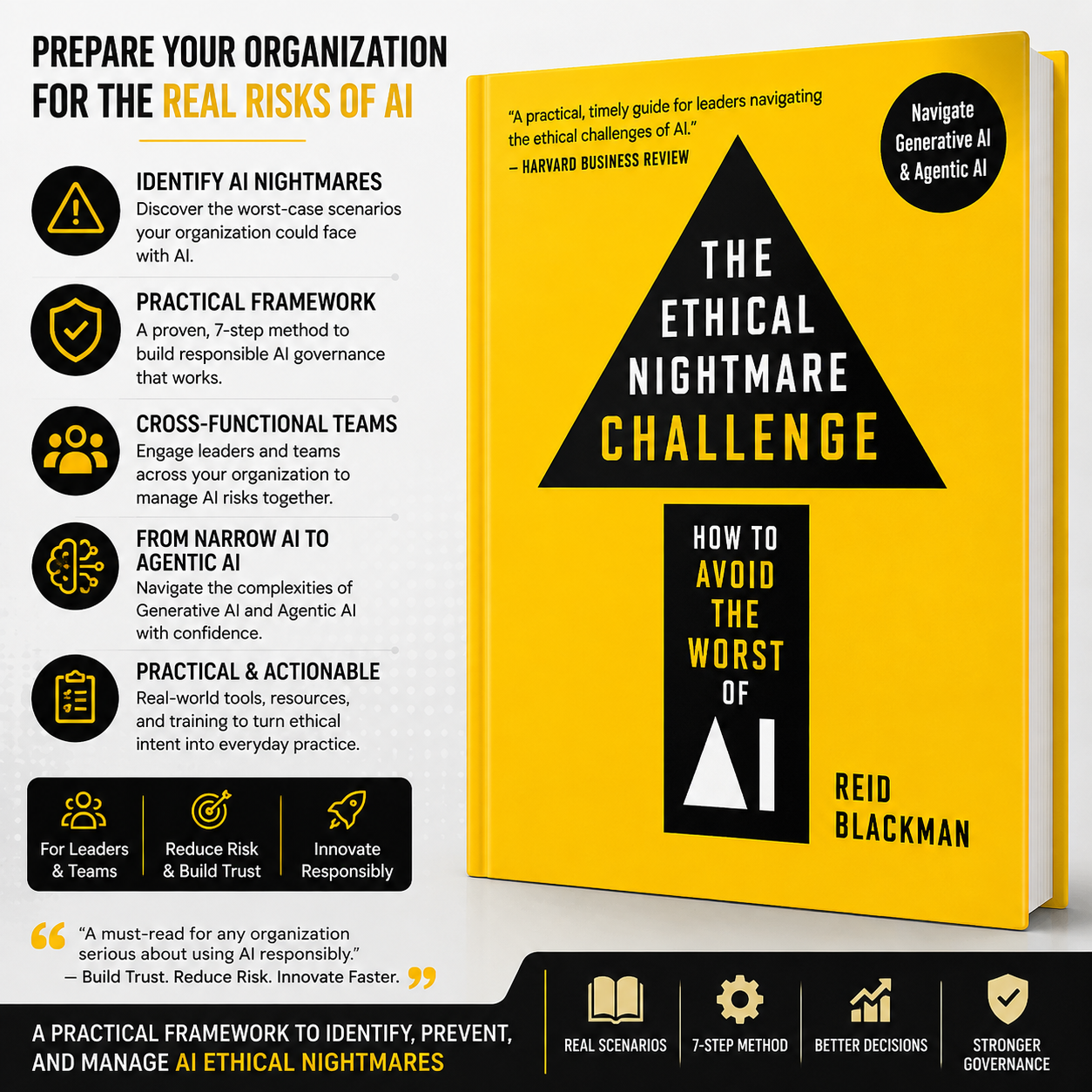
For business leaders and professionals responsible for AI governance, The Ethical Nightmare Challenge: How to Avoid the Worst of AI by Reid Blackman offers a different way to think about responsible AI.
Rather than starting with a long list of policies and rules, the book focuses on identifying the worst things that could happen when organizations use AI and developing practical resources to prevent those outcomes.
The book was published in 2026 and focuses on the changing AI risk landscape, from traditional AI systems to generative and agentic AI.
What Is The Ethical Nightmare Challenge About?
The Ethical Nightmare Challenge examines why traditional approaches to Responsible AI and AI governance can struggle to keep up with rapidly changing technology.
In the past, organizations often relied heavily on enterprise-wide policies and governance frameworks. But as generative AI and agentic AI evolve, updating those policies can become increasingly difficult.
Reid Blackman argues for a more practical, outcome-oriented approach: identify the organization’s potential AI ethical nightmares, determine what resources are needed to prevent them, and train people to use those resources effectively.
This makes the book particularly relevant for organizations that are already using AI or preparing to deploy more advanced AI systems.
What Is an AI Ethical Nightmare?
The concept behind the book is relatively straightforward.
Instead of asking only:
“Do we have an AI policy?”
organizations should also ask:
“What are the worst things that could happen if we use AI?”
These scenarios might involve privacy, discrimination, inaccurate decisions, security, reputational damage, inappropriate automation, or other consequences specific to an organization’s industry and AI applications.
The objective is not to assume that every possible risk will occur.
Instead, teams can identify plausible high-impact scenarios and then develop practical ways to reduce the likelihood or severity of those outcomes.
Why Traditional AI Governance Can Struggle
AI technology is developing much faster than many traditional corporate processes.
An organization might spend considerable time creating, reviewing, and approving an enterprise AI policy. But by the time that policy is implemented, the organization may already be experimenting with new generative AI tools or autonomous AI agents.
Blackman argues that this creates a fundamental problem: AI governance needs to be able to adapt at the same pace as AI adoption.
His argument has also been discussed in Harvard Business Review, where he explains why traditional Responsible AI approaches can become too slow and difficult to apply as AI systems become more complex.
The Three Questions Behind the Ethical Nightmare Challenge
At the heart of the framework are three practical questions:
1. What Are Your Organization’s AI Ethical Nightmares?
The first step is identifying the specific negative outcomes an organization wants to prevent.
These will vary depending on the company, industry, customers, technology, and use case.
For example, an organization might need to consider potential problems involving:
- Sensitive data
- AI hallucinations
- Bias
- Privacy
- Security
- Automated decision-making
- AI agents acting without appropriate oversight
- Reputational damage
- Customer harm
- Regulatory or legal exposure
The important point is to make these risks concrete and understandable rather than leaving them as vague ethical principles.
2. What Resources Will You Build to Avoid Them?
Identifying a potential problem is only the beginning.
Organizations also need resources that help employees recognize and respond to those risks.
These resources could include processes, guidelines, training materials, tools, escalation procedures, or other practical safeguards.
The goal is to turn AI ethics from an abstract concept into something employees can actually use while working with AI.
3. How Will You Train People to Use Those Resources?
Even the best governance framework will have limited value if employees do not understand how to use it.
Training therefore becomes an important part of the approach.
Employees need to understand not only what the organization considers risky, but also what they should do when they encounter a potential AI problem.
These three questions form the core of the Ethical Nightmare Challenge framework.
What Is the 7-Step ENC Method?
The book also introduces a 7-Step Ethical Nightmare Challenge Method for organizations.
The framework involves activities such as creating the appropriate team, establishing a baseline understanding of AI risks, identifying and scoring ethical nightmares, developing resources and training, assigning responsibilities, and assessing progress.
This approach is intended to make AI risk management more actionable.
Instead of having a small group of executives create rules that everyone else must follow, the framework encourages cross-functional teams to work directly on specific AI risks and potential outcomes.
Why Agentic AI Makes This More Important
Generative AI already creates new challenges for organizations.
But agentic AI introduces another layer of complexity.
An AI agent may be designed to perform multiple steps, interact with tools, retrieve information, make decisions, and take actions with less direct human involvement.
That means organizations need to think about more than just whether an AI-generated answer is accurate.
They also need to consider:
- What can the AI agent access?
- What decisions can it make?
- What actions can it take?
- What happens when it makes a mistake?
- Who is responsible for the outcome?
- When should human intervention be required?
Blackman’s work specifically addresses the transition from traditional AI risks toward the increasingly complex risks associated with generative and agentic AI.
Moving Beyond Compliance Theater
One of the book’s central themes is the difference between having policies and actually being prepared for AI risks.
A company can have a sophisticated Responsible AI document and still struggle when an unexpected AI problem appears.
The Ethical Nightmare Challenge emphasizes practical preparation rather than simply creating more documentation.
The idea is to build teams and resources that can respond to specific risks in real-world situations.
This is particularly important as AI becomes embedded in more business processes.
Who Should Read The Ethical Nightmare Challenge?
This book may be particularly useful for:
- Business leaders
- CEOs and executives
- AI governance professionals
- Chief AI Officers
- Technology leaders
- Risk managers
- Compliance professionals
- Legal teams
- AI product managers
- Data and AI teams
- Responsible AI professionals
- Enterprise organizations adopting generative AI
- Companies exploring agentic AI
It can also be useful for professionals who need to understand the broader implications of AI beyond technology and productivity.
Is This a Beginner AI Book?
Not in the same sense as a basic “AI for beginners” book.
The Ethical Nightmare Challenge is more focused on AI ethics, governance, organizational risk, and responsible AI implementation.
However, readers do not necessarily need to be AI engineers.
The subject is particularly relevant to people who are involved in decision-making, governance, risk management, business strategy, or AI implementation.
The book’s framework is designed to be applied at different levels of an organization, from enterprise leadership to individual departments and AI projects.
What Makes This Book Different?
The most interesting aspect of The Ethical Nightmare Challenge is its emphasis on specific negative outcomes rather than abstract principles alone.
Instead of beginning with a question such as:
“What should our AI ethics policy say?”
the approach asks:
“What could go seriously wrong here, and what can we do about it?”
That change in perspective can make AI risk conversations easier to understand across different departments.
Marketing, HR, product, technology, legal, and executive teams may all approach AI differently, but everyone can understand the consequences of a serious failure.
About Reid Blackman
Reid Blackman is an AI ethicist, advisor, speaker, and author specializing in AI ethics and governance.
He is the founder and CEO of Virtue, where he works with organizations on AI governance and ethical AI practices. He previously wrote Ethical Machines, another book focused on responsible AI.
His work combines philosophical ethics with practical experience advising organizations on AI-related risks.
Book Details
Title: The Ethical Nightmare Challenge: How to Avoid the Worst of AI
Author: Reid Blackman
Publisher: JETLAUNCH
Publication Year: 2026
Length: 198 pages
Language: English
Genre: Non-Fiction
Category: Artificial Intelligence / AI Ethics / AI Governance / Business Ethics
Topics: Responsible AI, AI Risk, AI Governance, Generative AI, Agentic AI, Business Ethics, Risk Management
ISBN: 9798890794840
Where to Buy The Ethical Nightmare Challenge
If you are interested in understanding AI ethics, AI governance, responsible AI, and the risks associated with generative and agentic AI, you can check the current Amazon listing here:
👉 Check The Ethical Nightmare Challenge on Amazon
Final Thoughts
Artificial intelligence creates enormous opportunities for businesses, but those opportunities also come with risks.
As organizations move from traditional AI toward generative AI and increasingly autonomous AI agents, simply having a written AI policy may not be enough.
The Ethical Nightmare Challenge by Reid Blackman presents a practical framework centered on identifying potential AI “nightmares,” developing resources to avoid them, and training people to respond effectively.
The book’s central idea is particularly relevant for organizations that want to move beyond theoretical discussions about AI ethics and focus on practical risk prevention.
For readers searching for an AI ethics book, AI governance book, Responsible AI guide, AI risk management book, generative AI governance resource, or agentic AI ethics guide, The Ethical Nightmare Challenge offers a timely perspective on one of the most important challenges facing businesses adopting artificial intelligence.