The ChatGPT Handbook for Beginners by Jakob Huber: A Practical Guide to Using ChatGPT
Artificial intelligence is becoming increasingly common in everyday work, education, content creation, and digital productivity.
Among the many AI tools available today, ChatGPT is one of the easiest for beginners to experiment with. However, knowing that ChatGPT exists and knowing how to use it effectively are two different things.
A new user may understand how to open a ChatGPT conversation but still struggle with questions such as:
What should I ask ChatGPT?
How should I write a useful prompt?
How can ChatGPT help with everyday tasks?
How can I organize my workflow with AI?
What are ChatGPT’s limitations?
How can I get more consistent results?
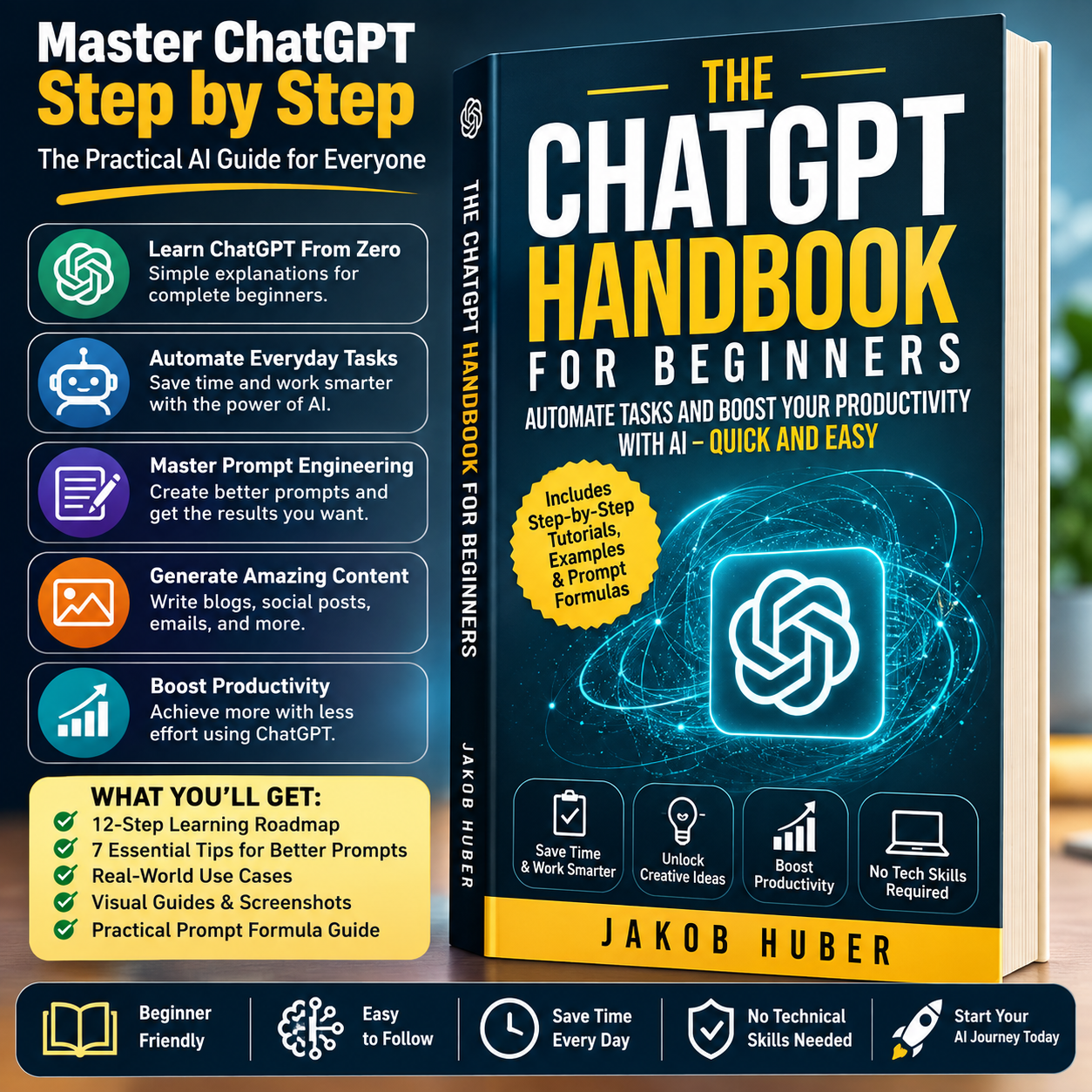
The ChatGPT Handbook for Beginners: Automate Tasks and Boost Your Productivity With AI – Quick and Easy by Jakob Huber is designed to provide a beginner-friendly introduction to these topics.
The book was published in 2025 and is positioned as a practical guide for readers without a technical background.
What Is The ChatGPT Handbook for Beginners About?
The book focuses on helping newcomers understand and use ChatGPT in practical situations.
Rather than approaching artificial intelligence from a programming or engineering perspective, it focuses on the user experience.
The topics presented in the book include:
Setting up and getting started with ChatGPT
Understanding ChatGPT features
Creating effective prompts
Prompt engineering
Automating repetitive tasks
Improving productivity
Practical AI applications
Image-generation prompting
Common ChatGPT limitations
Avoiding common mistakes
The book’s description also highlights a 12-step roadmap, step-by-step tutorials, visual aids, screenshots, examples, and practical prompt guidance.
Why a Beginner’s ChatGPT Guide Can Be Useful
ChatGPT is relatively easy to access, but getting useful results consistently can take some practice.
A beginner might start by asking simple questions and quickly discover that the quality of the response depends heavily on how the task is explained.
For example, a vague request such as:
“Write a product description.”
may produce a generic result.
A more detailed instruction could specify:
The product
Target audience
Writing style
Length
Important features
Information that must be included
Information that should be avoided
This gives the AI more context and makes the desired outcome clearer.
Learning how to provide this context is one of the practical skills associated with prompt engineering.
What Is Prompt Engineering?
Prompt engineering is the process of designing and refining instructions for an AI system.
It does not necessarily require programming knowledge.
For everyday ChatGPT users, it can be as simple as learning how to structure requests more clearly.
A useful prompt can contain several elements:
Role
Tell ChatGPT what perspective or role it should take.
Task
Clearly explain what you want it to do.
Context
Provide the information it needs to understand the situation.
Format
Explain how you want the answer presented.
Constraints
Specify limitations such as length, tone, audience, or information that should not be included.
This structured approach can make ChatGPT more useful for repeated tasks.
A 12-Step Approach to Learning ChatGPT
The book description highlights a 12-step roadmap intended to guide readers from setting up an account toward becoming more comfortable with ChatGPT.
For someone completely new to AI, a structured learning path can be easier to follow than randomly experimenting with different prompts.
The general idea is to learn progressively:
Understand the basics.
Become familiar with the interface.
Learn how conversations work.
Experiment with prompts.
Explore different features.
Apply ChatGPT to simple tasks.
Improve prompt quality.
Create repeatable workflows.
Explore more advanced applications.
Learn common limitations.
Review and improve results.
Develop your own practical workflow.
The exact value of such a roadmap depends on how actively the reader practices the concepts.
Using ChatGPT for Productivity
One of the most practical applications of ChatGPT is assisting with routine knowledge-work tasks.
For example, users can potentially ask ChatGPT to help with:
Brainstorming
Writing drafts
Creating outlines
Summarizing provided information
Organizing notes
Creating checklists
Rewriting text
Generating ideas
Preparing questions
Structuring projects
The important distinction is that AI assistance does not eliminate the need for human review.
Users should still check the output, especially when accuracy or context is important.
Automating Repetitive Tasks
The book also focuses on automation.
Automation can mean different things depending on the user’s workflow.
Sometimes it involves using AI to assist with repetitive text-based tasks. In other cases, ChatGPT can become one component within a larger workflow involving other applications or tools.
For beginners, it is often useful to start small.
Instead of trying to automate an entire business process, identify one repetitive task and determine whether AI can assist with part of it.
For example, a user might create a repeatable prompt for:
Customer-response drafts
Content ideas
Product descriptions
Research summaries
Meeting-note organization
Social-media drafts
This can create a more consistent workflow without requiring advanced programming.
ChatGPT for Content Creation
Content creators can potentially use ChatGPT throughout the content-development process.
For example, ChatGPT can assist with:
Topic brainstorming
Article outlines
Headline ideas
Social-media concepts
Video scripts
Email drafts
Content calendars
Rewriting
Editing
However, publishing AI-generated content without review is not a good workflow.
A human should check the information, improve the writing, add original insights, and make sure the final content genuinely provides value.
For blog owners, this is particularly important because useful content should be written for readers rather than created solely to generate search traffic.
ChatGPT for Everyday Work
The usefulness of ChatGPT is not limited to content creation.
Professionals can potentially use it as an assistant for a wide variety of tasks.
For example:
Planning: Create a project outline or checklist.
Writing: Create an initial draft that can later be edited.
Research preparation: Generate questions or organize information that the user provides.
Communication: Draft emails or messages that the user reviews before sending.
Learning: Ask for explanations of unfamiliar concepts.
Organization: Transform unstructured notes into a clearer format.
These applications can make AI useful even for people who never intend to become AI professionals.
Using ChatGPT for Image Generation
The book description also mentions techniques related to image generation.
For beginners, learning to describe an image clearly can be an interesting introduction to multimodal AI.
A good image prompt can specify things such as:
Subject
Setting
Composition
Lighting
Perspective
Mood
Visual style
Aspect ratio
Important elements
As with text generation, experimentation and refinement are often necessary.
Understanding ChatGPT’s Limitations
Learning how to use AI effectively also means understanding when not to trust it.
ChatGPT can produce responses that sound convincing while containing inaccurate information.
It may misunderstand context, make factual mistakes, or provide outdated information depending on the task and information available to it.
For this reason, important information should be independently verified.
This is especially important for:
Financial decisions
Medical information
Legal matters
Safety-related information
Technical specifications
Current events
Professional decisions
AI can be useful as an assistant, but it should not automatically be treated as an authoritative source.
The book itself includes discussion of ChatGPT’s limitations and common mistakes.
Who Is The ChatGPT Handbook for Beginners For?
This book may be particularly suitable for:
Complete ChatGPT beginners
Students
Freelancers
Content creators
Bloggers
Entrepreneurs
Small business owners
Digital marketers
Office professionals
Non-technical users
People interested in AI productivity
The book’s positioning specifically emphasizes accessibility for people who may feel overwhelmed by technical AI terminology.
Is This a Technical AI Book?
No.
The ChatGPT Handbook for Beginners is not primarily a programming textbook.
You will not need advanced knowledge of machine learning mathematics, neural networks, or AI model development to understand its intended material.
Instead, the book focuses on using ChatGPT as an everyday AI tool.
If your goal is to learn Python and build machine-learning models, a more technical book would be appropriate.
But if your goal is to become more comfortable with ChatGPT and learn practical ways to incorporate it into your workflow, this type of beginner handbook is more relevant.
What Makes This Book Beginner-Friendly?
The book emphasizes several features intended to make learning easier:
Step-by-step instructions
Visual aids
Screenshots
Practical examples
Prompt examples
A structured learning roadmap
Explanations without heavy technical terminology
These elements can be particularly useful for readers who prefer learning by following examples instead of reading highly theoretical explanations.
About the Author
Jakob Huber is the author of The ChatGPT Handbook for Beginners and several other books related to technology and practical AI use.
Bibliographic sources identify Huber as the author and list the book as a 2025 publication.
Book Details
Title:The ChatGPT Handbook for Beginners: Automate Tasks and Boost Your Productivity With AI – Quick and Easy
Affiliate disclosure: This article contains an affiliate link. If you make a purchase through the link, the publisher of this website may receive a commission at no additional cost to you.
Final Thoughts
ChatGPT can be surprisingly useful, but getting good results requires more than simply typing a question into a chat window.
Understanding how to structure prompts, provide context, evaluate responses, and create repeatable workflows can make AI much more practical for everyday use.
The ChatGPT Handbook for Beginners by Jakob Huber focuses on exactly this beginner stage.
It introduces ChatGPT through step-by-step guidance, practical examples, prompt techniques, productivity applications, automation concepts, image-generation techniques, and discussions about common limitations.
It is best viewed as an introductory practical guide, rather than a technical AI textbook.
For readers searching for a ChatGPT book for beginners, ChatGPT guide, prompt engineering book, AI productivity guide, ChatGPT automation guide, or beginner AI handbook, this title may be worth exploring.

 Artificial intelligence is becoming increasingly common in everyday work, education, content creation, and digital productivity.