Co-Intelligence by Ethan Mollick: How to Live and Work with AI
Artificial intelligence is changing the way people work, learn, create, and solve problems. But instead of asking whether AI will simply replace humans, a more interesting question is how humans can work together with AI to become more capable.
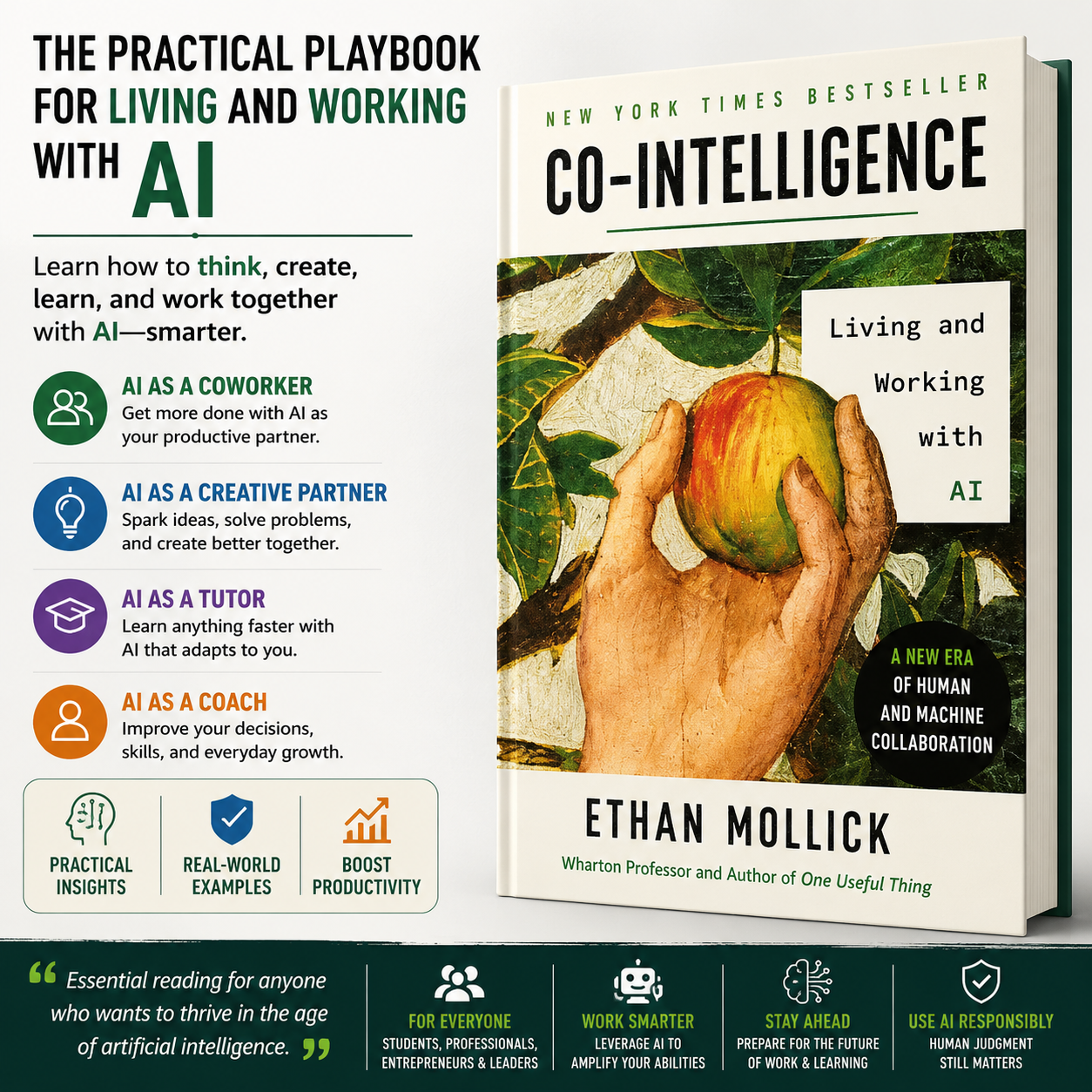
That is the central idea behind Co-Intelligence: Living and Working with AI by Ethan Mollick.
Written by Wharton professor Ethan Mollick, the book explores how people can use generative AI as a co-worker, creative partner, tutor, and coach while still maintaining human judgment and responsibility.
What Is Co-Intelligence About?
Co-Intelligence is a practical and thought-provoking book about living and working in the age of generative artificial intelligence.
Mollick argues that AI should not necessarily be viewed only as a tool that performs tasks for humans. Instead, people can learn to collaborate with AI and use it to extend their own abilities.
The book explores what happens when AI becomes part of everyday activities such as:
Writing
Brainstorming
Learning
Research
Business
Teaching
Creative work
Problem-solving
Decision-making
Personal productivity
Rather than focusing entirely on the technical mechanics behind AI models, Mollick concentrates on how people can actually interact with these systems and use them effectively.
What Does “Co-Intelligence” Mean?
The term co-intelligence describes the idea of combining human intelligence with artificial intelligence.
Instead of thinking of AI as either a replacement for people or simply another software application, Mollick encourages readers to experiment with AI as a collaborator.
This does not mean blindly trusting AI.
In fact, one of the important themes of the book is learning how to use AI while recognizing its limitations. AI can produce useful ideas and impressive results, but it can also make mistakes, generate misleading information, or fail in unexpected ways.
The human therefore remains an important part of the process.
AI as a Coworker
One of the most practical concepts in the book is treating AI as a coworker.
AI can assist with tasks such as drafting documents, generating ideas, summarizing information, creating plans, and exploring possible solutions.
For entrepreneurs and small business owners, this can be particularly interesting.
A business owner may need to handle marketing, writing, research, customer communication, planning, and many other responsibilities. AI can potentially provide assistance across several of these areas.
Wharton highlights Mollick’s view that entrepreneurs can benefit from experimenting with AI across many parts of their work rather than assuming in advance that they know exactly where AI will be useful.
AI as a Creative Partner
AI can also be used as a brainstorming and creative partner.
For example, a person could ask AI to:
Generate ideas
Suggest alternative approaches
Critique a draft
Explore different perspectives
Develop possible concepts
Help organize ideas
Rewrite content for different audiences
The human still decides which ideas are valuable and which should be rejected.
This distinction is important because AI-generated content is not automatically correct or useful simply because it sounds convincing.
AI as a Tutor
Another role explored in Co-Intelligence is AI as a tutor.
AI can potentially explain concepts in different ways, answer follow-up questions, create exercises, and adapt explanations to a learner’s level.
This creates interesting possibilities for people who want to learn new subjects or practice skills.
Instead of receiving exactly the same explanation every time, a learner can interact with an AI system and ask it to explain a difficult concept from another perspective.
The book dedicates a section specifically to AI’s role as a tutor and examines how this could affect education and learning.
AI as a Coach
Mollick also explores AI as a coach.
In this role, AI can help people think through problems, practice skills, explore alternatives, or receive feedback.
This does not mean AI replaces experienced human coaches or professionals.
Instead, it can serve as an additional resource for reflection and practice.
The book’s table of contents includes dedicated chapters on AI as a tutor and AI as a coach, showing how important these roles are to Mollick’s broader concept of co-intelligence.
The Importance of Keeping Humans in the Loop
One of the most important ideas when working with AI is that people should remain actively involved.
AI can be surprisingly capable, but it also has limitations.
It may misunderstand context, produce inaccurate information, or confidently provide an answer that sounds plausible but is incorrect.
That means users need to evaluate AI output rather than automatically accepting everything it produces.
This human-AI collaboration is at the heart of Mollick’s approach.
The goal is not simply to make AI do more work.
The goal is to understand which tasks AI can help with, where human expertise matters most, and how the two can work together effectively.
Four Rules for Co-Intelligence
The book presents four rules for working with AI.
They provide a useful framework for people who are beginning to incorporate generative AI into their daily lives.
1. Invite AI to the Table
Experiment with AI instead of assuming that you already know what it can or cannot do.
Different professions and tasks may reveal unexpected applications.
2. Be the Human in the Loop
AI can be powerful, but humans still need to provide judgment, context, goals, and oversight.
3. Treat AI Like a Person
Mollick suggests interacting with AI using natural language and giving it context, roles, and clear instructions.
This can make AI interactions more useful.
4. Assume This Is the Worst AI You Will Ever Use
AI technology continues to develop rapidly.
Today’s systems may look very different from future versions, which means learning how to adapt can be just as important as learning a particular tool. These four principles are also highlighted in a Stanford Graduate School of Business discussion featuring Mollick.
Co-Intelligence and Business
AI is particularly relevant to businesses because many knowledge-based tasks involve activities that generative AI can assist with.
Examples include:
Marketing
Writing
Research
Customer communication
Brainstorming
Business planning
Data interpretation
Product development
Education and training
Mollick’s perspective is especially interesting for entrepreneurs because small businesses often have limited resources.
AI can potentially help a small team perform tasks that would otherwise require additional time or specialized assistance. Wharton specifically discusses Mollick’s view of AI as a useful resource for entrepreneurs who need to handle many different aspects of running a business.
AI Is Not Always Right
Despite the potential of AI, Co-Intelligence does not present artificial intelligence as a perfect technology.
This is an important distinction.
AI systems can produce impressive results while still making mistakes.
Users therefore need to understand both the capabilities and limitations of AI.
This is especially important when AI is used for important decisions, professional advice, research, financial matters, or other situations where inaccurate information could have serious consequences.
The book encourages readers to learn through experimentation while maintaining appropriate skepticism and human oversight.
Who Should Read Co-Intelligence?
This book may be especially interesting for:
Entrepreneurs
Business owners
Managers
Professionals
Students
Teachers
Content creators
Writers
Researchers
Digital marketers
Technology enthusiasts
Anyone interested in generative AI
You do not need to be an AI engineer to understand the main ideas.
The book focuses more on using and thinking about AI than on programming AI systems.
Is Co-Intelligence a Technical AI Book?
No.
Co-Intelligence is better described as a business, productivity, and practical AI book rather than a technical programming textbook.
You will not need advanced mathematics or programming knowledge to follow the main concepts.
Instead, the book asks broader questions about how AI affects work, education, creativity, organizations, and everyday life.
About the Author
Ethan Mollick is a professor of management at the Wharton School, where he specializes in entrepreneurship and innovation.
He is also known for his writing about artificial intelligence and the One Useful Thing newsletter.
His work focuses heavily on the practical implications of emerging AI technologies and how people and organizations can adapt to them.
Book Details
Title:Co-Intelligence: Living and Working with AI Author: Ethan Mollick Publisher: Portfolio / Penguin Publication: April 2, 2024 Language: English Genre: Non-Fiction Category: Artificial Intelligence / Business & Economics Topics: Generative AI, Productivity, Business, Education, Creativity, AI Collaboration Format: Kindle, Hardcover, Paperback, and Audiobook editions may be available. Length: Edition-dependent; the U.S. editions listed by Google Books include 234- and 256-page editions.
Where to Buy Co-Intelligence
If you want to learn more about using generative AI for work, learning, creativity, and everyday productivity, you can check the current Amazon listing here:
Co-Intelligence: Living and Working with AI offers an interesting perspective on the relationship between people and artificial intelligence.
Instead of framing AI simply as something that will replace human workers, Ethan Mollick explores how people can work with AI as a collaborator, creative partner, tutor, and coach.
The most useful takeaway may be that becoming good at AI is not only about learning how to use a particular application.
It is also about learning how to think with AI, how to give it useful context, how to evaluate its output, and how to recognize where human judgment remains essential.
For readers searching for an AI book for business, generative AI book, ChatGPT productivity book, AI book for entrepreneurs, artificial intelligence book for beginners, or practical guide to working with AI, Co-Intelligence is a compelling title to explore.

 Artificial intelligence is changing the way people work, learn, create, and solve problems. But instead of asking whether AI will simply replace humans, a more interesting question is how humans can work together with AI to become more capable.