ChatGPT Uses & Prompts: A QuickStudy Laminated Reference Guide – A Practical AI Reference for Beginners
Artificial intelligence has become increasingly useful for everyday tasks, but learning how to communicate effectively with AI can take time. For people who want a quick reference instead of reading through lengthy tutorials, ChatGPT Uses & Prompts: A QuickStudy Laminated Reference Guide by Frank Blackwell offers a compact alternative.
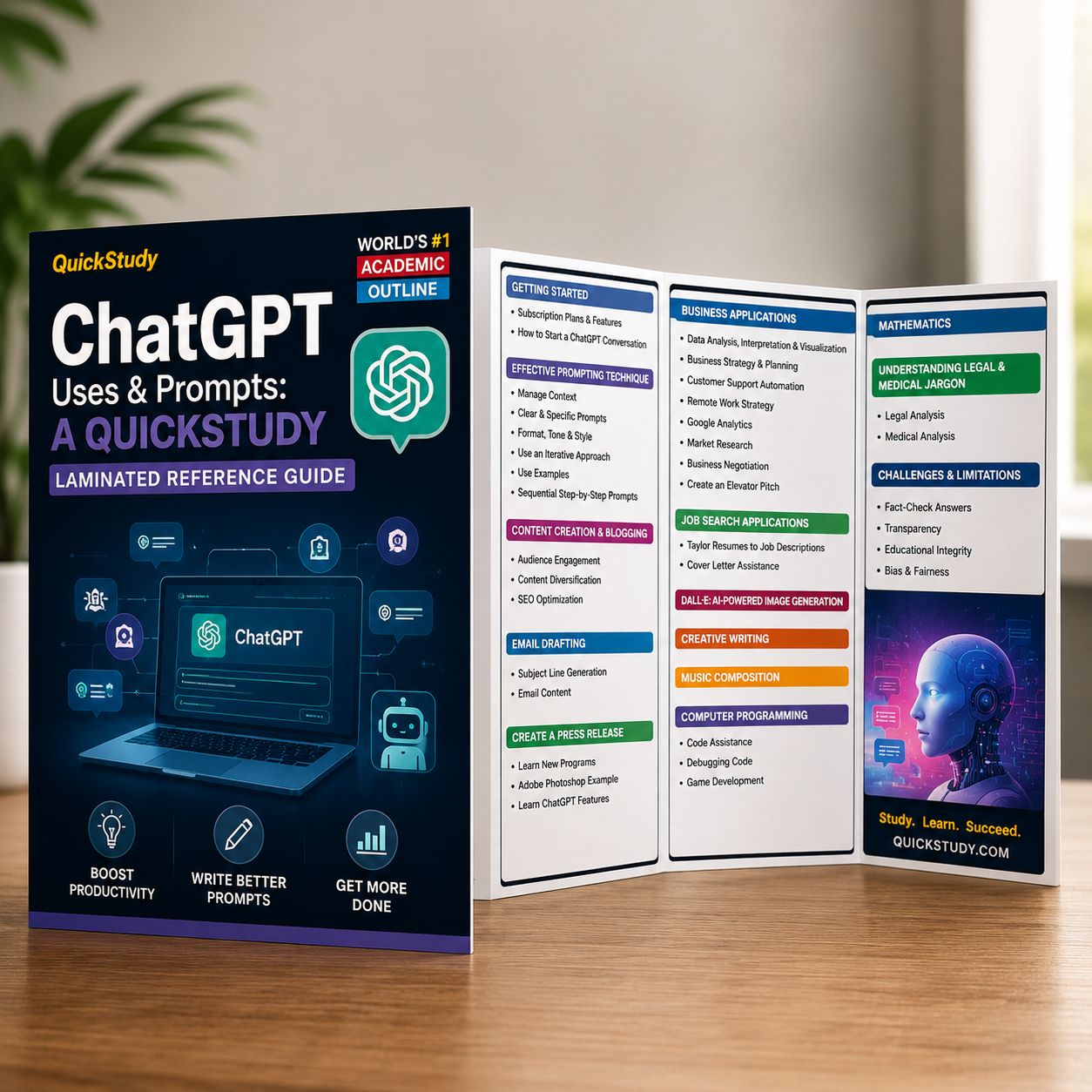
Based on the product information shown in the listing, this laminated reference guide is designed to provide practical information about ChatGPT, prompting techniques, content creation, business applications, programming, and other common AI-related topics.
Its compact format makes it different from a conventional book. Instead of hundreds of pages, the listed edition contains 6 pages and is presented as a laminated reference guide.
What Is ChatGPT Uses & Prompts?
ChatGPT Uses & Prompts: A QuickStudy Laminated Reference Guide is a reference pamphlet created by Frank Blackwell.
The guide is designed to help readers quickly find information about using ChatGPT and writing better prompts. Rather than presenting a long-form discussion about artificial intelligence, it organizes practical topics into sections that can be used as a quick reference.
According to the product listing, the guide covers subjects including:
ChatGPT subscription plans and features
Starting a ChatGPT conversation
Effective prompting techniques
Content creation and blogging
Email drafting
Press releases
Business applications
Job search applications
AI-powered image generation
Creative writing
Music composition
Computer programming
Mathematics
Legal and medical terminology
Challenges and limitations of AI
This broad range of subjects makes the guide relevant to readers who want an overview of different ways ChatGPT and AI tools can be used.
A Quick Reference Rather Than a Traditional AI Book
One of the most noticeable characteristics of this product is its format.
The listing identifies it as a pamphlet, rather than a conventional hardcover or paperback book. It is also described as a laminated reference guide.
That distinction is important when deciding whether it is suitable for you.
If you are looking for a detailed textbook explaining artificial intelligence from beginning to end, a six-page reference guide will obviously have a different purpose.
However, if you prefer something concise that you can keep nearby while working with AI tools, a quick-reference format can be more convenient.
What Can You Learn From the Guide?
1. Getting Started With ChatGPT
For people who are new to ChatGPT, knowing where to begin can sometimes be confusing.
The guide includes a Getting Started section covering topics such as subscription plans, features, and how to start a ChatGPT conversation.
This provides a basic starting point for users who are still becoming familiar with AI assistants.
2. Effective Prompting Techniques
Prompting is one of the central topics in the guide.
A prompt is essentially the instruction or information you provide to an AI system.
For example, instead of simply writing:
Write an article.
A more useful instruction could specify:
Write a 1,000-word article about beginner photography for readers who are buying their first camera. Use simple English and organize the article with clear headings.
The second instruction gives the AI more context and direction.
The guide lists several prompting concepts, including:
Managing context
Clear and specific prompts
Format, tone, and style
Iterative prompting
Using examples
Sequential step-by-step prompts
These concepts can be useful for beginners who want to become more deliberate when communicating with AI.
ChatGPT for Content Creation and Blogging
Another section of the reference guide focuses on content creation and blogging.
The listed topics include:
Audience engagement
Content diversification
SEO optimization
These areas can be particularly relevant to bloggers and content creators.
AI can be used to brainstorm topics, organize an outline, generate alternative ideas, and assist with editing. However, AI-generated content should still be reviewed by a human before publication.
Writers should check facts, remove unsupported claims, improve originality, and make sure the final article genuinely provides value to readers.
Using AI as an assistant rather than publishing unreviewed output can lead to a more useful workflow.
Email Drafting With AI
The guide also includes a section dedicated to email drafting.
The listed subjects include:
Subject line generation
Email content
This can be useful for people who regularly write business or personal emails.
For example, AI can help generate several possible subject lines or create a first draft based on information provided by the user.
The final message should still be reviewed before sending, especially when the email contains sensitive information, business decisions, or important commitments.
Business Applications
The reference guide also includes several business-related applications.
According to the product listing, these include:
Data analysis, interpretation, and visualization
Business strategy and planning
Customer support automation
Remote work strategy
Google Analytics
Market research
Business negotiation
Creating an elevator pitch
These examples demonstrate how broad the potential applications of AI can be.
However, the presence of a topic in a reference guide does not mean that AI will automatically perform the task accurately or replace professional expertise.
For important business decisions, AI-generated information should be reviewed and independently verified.
AI and Job Search Applications
Another topic covered is the use of AI for job searches.
The listed examples include:
Tailoring resumes to job descriptions
Cover letter assistance
AI can help users organize information from a job description and create a draft that reflects relevant skills.
However, applicants should ensure that the final resume and cover letter accurately represent their real experience and qualifications.
AI should not be used to fabricate employment history, qualifications, certifications, or other personal information.
AI-Powered Image Generation
The reference guide also mentions DALL·E and AI-powered image generation.
Generative image tools can be useful for brainstorming visual concepts, creating illustrations, developing mockups, or exploring creative directions.
When using AI-generated images commercially, users should still pay attention to the terms and conditions of the specific AI service and ensure that their use of generated material is appropriate.
Creative Writing and Music
The guide extends beyond business applications and includes creative uses of AI.
Topics listed include:
Creative writing
Music composition
These applications demonstrate how AI can be used as a brainstorming and creative-assistance tool.
A writer might use AI to explore character ideas or story structures, while a musician could use an AI system to experiment with concepts.
The creative direction and final decisions can remain with the human creator.
Computer Programming
For people interested in technology, the guide includes a section covering computer programming.
The listed topics include:
Code assistance
Debugging code
Game development
AI coding assistants can help explain code, suggest possible solutions, or identify potential problems.
Nevertheless, generated code should always be reviewed and tested. A program that looks correct at first glance may still contain errors or security issues.
Mathematics and Specialized Information
The guide also references mathematics as well as legal and medical terminology.
These are areas where additional caution is particularly important.
AI can help explain complicated concepts in simpler language, but it should not automatically be treated as a substitute for qualified professionals.
For medical questions, professional medical advice should come from an appropriate healthcare professional.
Likewise, AI-generated legal information should not be treated as personalized legal advice.
Understanding AI Limitations
One of the more important topics listed in the guide is Challenges & Limitations.
The product information specifically mentions:
Fact-checking answers
Transparency
Educational integrity
Bias and fairness
These subjects are important because AI systems can produce answers that sound convincing while still containing errors.
For that reason, users should develop the habit of checking important information rather than assuming every AI response is correct.
Fact-Checking AI Responses
AI-generated information should be verified when accuracy matters.
This is especially important for:
Statistics
Dates
Scientific claims
Financial information
Legal information
Medical information
Names and quotations
Current events
A good AI workflow includes verification rather than blind acceptance.
Bias and Fairness
AI systems can also produce biased or incomplete results.
Users should therefore consider the context of an AI-generated response and evaluate whether the information is appropriate for its intended purpose.
Human judgment remains an important part of responsible AI use.
Who Might Find This Guide Useful?
Based on the topics shown in the product listing, the guide may be useful for several types of readers.
Beginners
People who are just starting with ChatGPT may appreciate having a compact reference covering basic concepts.
Bloggers and Content Creators
The sections on content creation, blogging, prompting, and SEO may be relevant to people who regularly publish online.
Business Professionals
The business applications section covers several areas that may be relevant to workplace AI experimentation.
Students
Students can potentially use a reference guide to understand basic prompting concepts and AI applications. However, they should follow their school’s or institution’s rules regarding acceptable AI use.
Job Seekers
The sections on resume customization and cover letters may be useful for people preparing job applications.
AI Enthusiasts
Anyone interested in exploring different applications of ChatGPT may find the broad topic coverage useful as a starting point.
Is This Guide Right for You?
Whether this product is a good fit depends largely on what you expect from it.
It may suit you if you want:
A compact AI reference
A laminated format
Basic ChatGPT guidance
Prompting ideas
A broad overview of AI applications
A quick reference for everyday use
You may prefer a longer book if you want:
In-depth AI theory
Detailed programming tutorials
Extensive case studies
Advanced prompt engineering
A comprehensive technical explanation of machine learning
The product’s six-page format suggests that its primary purpose is quick reference rather than extensive study.
About the Author
The product listing identifies Frank Blackwell as the author.
The guide is presented under the QuickStudy format, which focuses on concise reference material rather than long-form books.
Product Details
Title:ChatGPT Uses & Prompts: A QuickStudy Laminated Reference Guide
Author: Frank Blackwell
Format: Pamphlet
Publisher: QuickStudy
Language: English
Listed length: 6 pages
Publication date shown in the listing: January 1, 2025
Dimensions shown: 8.5 × 0.06 × 11 inches
The exact availability, price, and shipping options may change over time, so it is best to check the current product page before purchasing.
Where to Buy ChatGPT Uses & Prompts
If you are interested in this compact ChatGPT reference guide, you can check the current Amazon listing here:
The Amazon page can be used to check the latest price, availability, format, and other purchasing information.
Affiliate Disclosure: This article contains an affiliate link. If you purchase through the link, I may receive a commission at no additional cost to you.
Final Thoughts
ChatGPT Uses & Prompts: A QuickStudy Laminated Reference Guide takes a concise approach to learning about ChatGPT and AI applications.
Its main attraction is its compact laminated reference format combined with a broad selection of topics, ranging from prompting and blogging to business applications, programming, image generation, and AI limitations.
It should not be viewed as a replacement for a comprehensive AI textbook. Instead, its value is in providing a convenient reference that readers can consult while exploring different ways to work with AI.
For anyone searching for a ChatGPT reference guide, ChatGPT prompts guide, AI prompts for beginners, ChatGPT quick reference, AI productivity guide, ChatGPT guide for blogging, or laminated AI reference guide, this product is worth taking a closer look at.

 Artificial intelligence has become increasingly useful for everyday tasks, but learning how to communicate effectively with AI can take time. For people who want a quick reference instead of reading through lengthy tutorials, ChatGPT Uses & Prompts: A QuickStudy Laminated Reference Guide by Frank Blackwell offers a compact alternative.