The Savvy Guide for Generative AI Beginners: A Practical Guide to Using AI With Clarity
Generative AI is becoming part of everyday work. People are using AI tools to brainstorm ideas, write drafts, analyze information, create content, organize tasks, and explore new ways of working.
But getting useful results from generative AI is not simply about knowing which tool to open.
Users also need to understand how to communicate with AI, when to rely on it, when to verify its output, and how to use it responsibly.
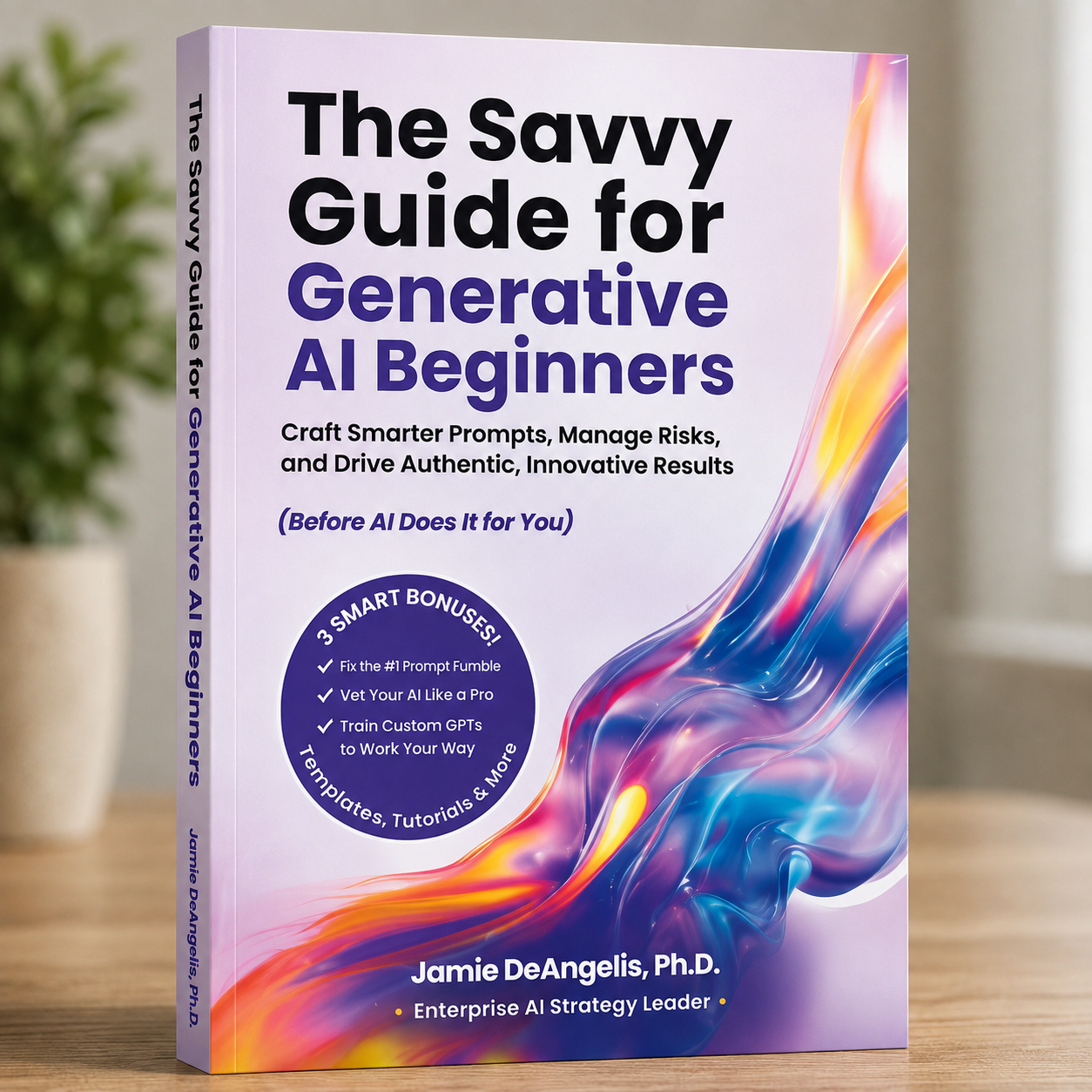
That is the focus of The Savvy Guide for Generative AI Beginners: Craft Smarter Prompts, Manage Risks, and Drive Authentic, Innovative Results (Before AI Does It for You) by Jamie DeAngelis, Ph.D.
The book was released in 2025 and is positioned as a practical, human-centered introduction to generative AI for professionals, leaders, marketers, creatives, and other people who want to use AI without losing their own judgment and expertise.
What Is The Savvy Guide for Generative AI Beginners About?
The Savvy Guide for Generative AI Beginners focuses on the practical side of generative AI.
Rather than treating AI as a purely technical subject, the book looks at how people can incorporate generative AI into their existing work while maintaining human judgment.
The publisher describes the book as covering areas such as:
Understanding how generative AI works
Writing better prompts
Using AI strategically
Building custom AI tools
Managing ethical considerations
Understanding risks
Developing AI literacy
Integrating AI into professional workflows
The overall approach is designed to help readers understand not only what AI can do, but also where human expertise remains important.
Why Prompting Matters
One of the most practical topics surrounding generative AI is prompting.
A prompt is the instruction or information provided to an AI system to guide its response.
A vague prompt might produce a broad answer, while a more detailed prompt can provide information about:
The objective
The intended audience
Context
Desired format
Tone
Constraints
Relevant examples
For example, instead of asking an AI tool to “write a blog post,” a user could explain the topic, target audience, search intent, structure, tone, and information that must be included.
The book explores prompt mastery as one of its central areas, with an emphasis on crafting prompts that reflect the user’s own expertise rather than simply copying generic instructions.
Understanding Generative AI Before Using It
Learning how to write prompts is useful, but understanding the technology behind them can also improve how people work with AI.
The book introduces readers to how generative AI works and why that knowledge matters.
This is important because AI output should not automatically be treated as fact.
Generative AI systems can produce fluent and convincing responses while still making mistakes. Users therefore need to evaluate information, verify important facts, and apply their own judgment.
Understanding this limitation is an important part of responsible AI use.
AI Should Support Human Expertise
One of the interesting ideas presented by the book is that AI does not have to replace a person’s expertise.
Instead, AI can be treated as a tool that helps people explore ideas, organize information, generate drafts, or work through repetitive tasks.
For example, a marketer could use AI to brainstorm campaign concepts while making the final strategic decisions themselves.
A writer could use AI to generate possible outlines but retain responsibility for the final article.
A manager could use AI to organize information but still evaluate the implications before making an important decision.
This approach keeps the human in control of the final outcome.
Using Custom GPTs and AI Tools
The book also discusses custom GPTs and ways professionals can create AI tools that are more closely aligned with their needs.
Custom tools can potentially be configured around particular instructions, workflows, or areas of expertise.
For a business or professional, this can be useful when the same type of task is performed repeatedly.
Examples might include:
Organizing recurring information
Drafting content according to a defined style
Creating structured brainstorming sessions
Assisting with internal workflows
Working with specific business guidelines
However, custom AI tools still require appropriate oversight, especially when they are used with confidential or sensitive information.
Managing AI Risks
Generative AI brings opportunities, but it also introduces risks.
The book specifically addresses areas such as ethics, intellectual property, bias, and accountability.
These subjects are important for anyone using AI professionally.
Accuracy
AI-generated information can contain errors.
Important claims should therefore be independently verified before publication or use.
Privacy
Users should consider what information they provide to an AI system, particularly when dealing with confidential business information or personal data.
Intellectual Property
AI-assisted content can raise questions about copyright, ownership, source material, and appropriate use.
The exact legal situation can vary depending on the circumstances and jurisdiction, so users should not assume that every AI-generated output is automatically free of legal or intellectual-property considerations.
Bias
AI systems can reflect biases present in their training data or surrounding processes.
Human review can help identify problematic assumptions or outputs.
Accountability
When AI contributes to an important decision or piece of work, someone still needs to take responsibility for reviewing the result.
AI can assist with a task, but responsibility should not simply disappear because software was involved.
AI for Professionals
The book is particularly relevant to people who are already working with information, communication, strategy, or creative tasks.
Potential readers include:
Business professionals
Entrepreneurs
Marketing professionals
Writers
Content creators
Strategists
Team leaders
Educators
Creative professionals
People beginning to explore generative AI
The author’s publisher describes the book as being written for professionals trying to stay relevant, leaders developing their teams, and marketers, creatives, and strategists looking for ways to use AI without losing their own voice.
AI Literacy Is More Than Knowing Prompts
There is a difference between knowing a collection of AI prompts and actually understanding how to work effectively with AI.
AI literacy involves asking questions such as:
What should I use AI for?
What should I continue doing myself?
How do I evaluate the output?
What information should I avoid sharing?
How can I integrate AI into an existing workflow?
What risks could arise from using AI for this particular task?
These questions are particularly important as AI becomes increasingly integrated into professional environments.
Using AI Without Losing Your Own Voice
One concern among writers, marketers, designers, and other creative professionals is that excessive dependence on AI can make content feel generic.
The book’s approach emphasizes using AI while retaining originality and expertise.
That can mean using AI for:
Brainstorming
First drafts
Alternative ideas
Research organization
Editing suggestions
Workflow assistance
The human creator can then decide what is actually useful and reshape the material according to their own knowledge and perspective.
This creates a workflow where AI contributes to the process rather than completely defining the finished work.
Practical AI Workflows
A useful AI workflow does not necessarily need to be complicated.
A simple process might look like this:
Define the goal → Give AI the relevant context → Generate ideas → Review the output → Verify important information → Edit → Finalize
This approach can be applied to many different tasks.
For example, someone creating a blog article could use AI to brainstorm topics and create an outline, then independently verify facts and edit the final article.
Someone managing a business workflow could use AI to organize information while retaining human approval for important decisions.
Who Should Read This Book?
The Savvy Guide for Generative AI Beginners may be a good starting point for people who want to understand generative AI from a practical rather than highly technical perspective.
It may be especially relevant if you are:
New to generative AI
Already experimenting with ChatGPT or similar tools
Interested in better prompting
A professional exploring AI at work
A business leader considering AI adoption
A marketer or content creator
Interested in AI ethics and responsible use
Looking for ways to integrate AI into existing workflows
The book is also potentially useful for readers who are interested in AI but do not want to begin with programming or advanced technical concepts.
About Jamie DeAngelis, Ph.D.
Jamie DeAngelis, Ph.D. is a brand strategist, content expert, educator, and generative AI leader.
According to the publisher, she leads a Generative AI Center of Excellence at a digital agency, where she works with engineering teams on AI solutions and helps organizations apply generative AI to practical business challenges. She also spent more than a decade teaching at the University of California, Berkeley.
Her background combines education, brand strategy, content, and generative AI, which is reflected in the book’s focus on making AI understandable and practical for professionals.
Book Details
Title:The Savvy Guide for Generative AI Beginners: Craft Smarter Prompts, Manage Risks, and Drive Authentic, Innovative Results (Before AI Does It for You)
Author: Jamie DeAngelis, Ph.D.
Publication year: 2025
Language: English
Genre: Business, technology, and artificial intelligence
Format shown in the provided listing: Paperback
The digital edition is listed at 143 pages by Apple Books, while other listings show different page counts for physical editions, so the exact number of pages depends on the format.
Where to Buy The Savvy Guide for Generative AI Beginners
If you want to check the current Amazon listing, available formats, and pricing, you can visit the book here:
Affiliate disclosure: This article contains an affiliate link. If you make a qualifying purchase through the link, the publisher of this website may receive a commission at no additional cost to you.
Final Thoughts
The Savvy Guide for Generative AI Beginners by Jamie DeAngelis, Ph.D. is aimed at readers who want a practical introduction to generative AI without approaching the subject purely from a technical perspective.
Its focus on prompting, AI literacy, custom tools, ethics, risk management, and professional workflows makes it relevant to people who are beginning to explore AI or want to use it more thoughtfully.
The book does not suggest that AI should replace human judgment. Instead, its approach emphasizes learning where AI can add value while preserving human expertise, originality, and responsibility.
For readers searching for a generative AI book for beginners, AI prompting guide, AI book for professionals, generative AI guide, AI literacy book, AI ethics guide, AI productivity book, or practical AI book for work, this title may be worth exploring.

 Generative AI is becoming part of everyday work. People are using AI tools to brainstorm ideas, write drafts, analyze information, create content, organize tasks, and explore new ways of working.