Master AI for Beginners by Charlie Hansen: A Practical Introduction to Artificial Intelligence
Artificial intelligence is becoming part of everyday technology, business, education, and professional work. Yet for someone who is completely new to AI, the subject can quickly become confusing.
Terms such as machine learning, neural networks, automation, algorithms, and artificial intelligence can make the technology seem more complicated than it really needs to be.
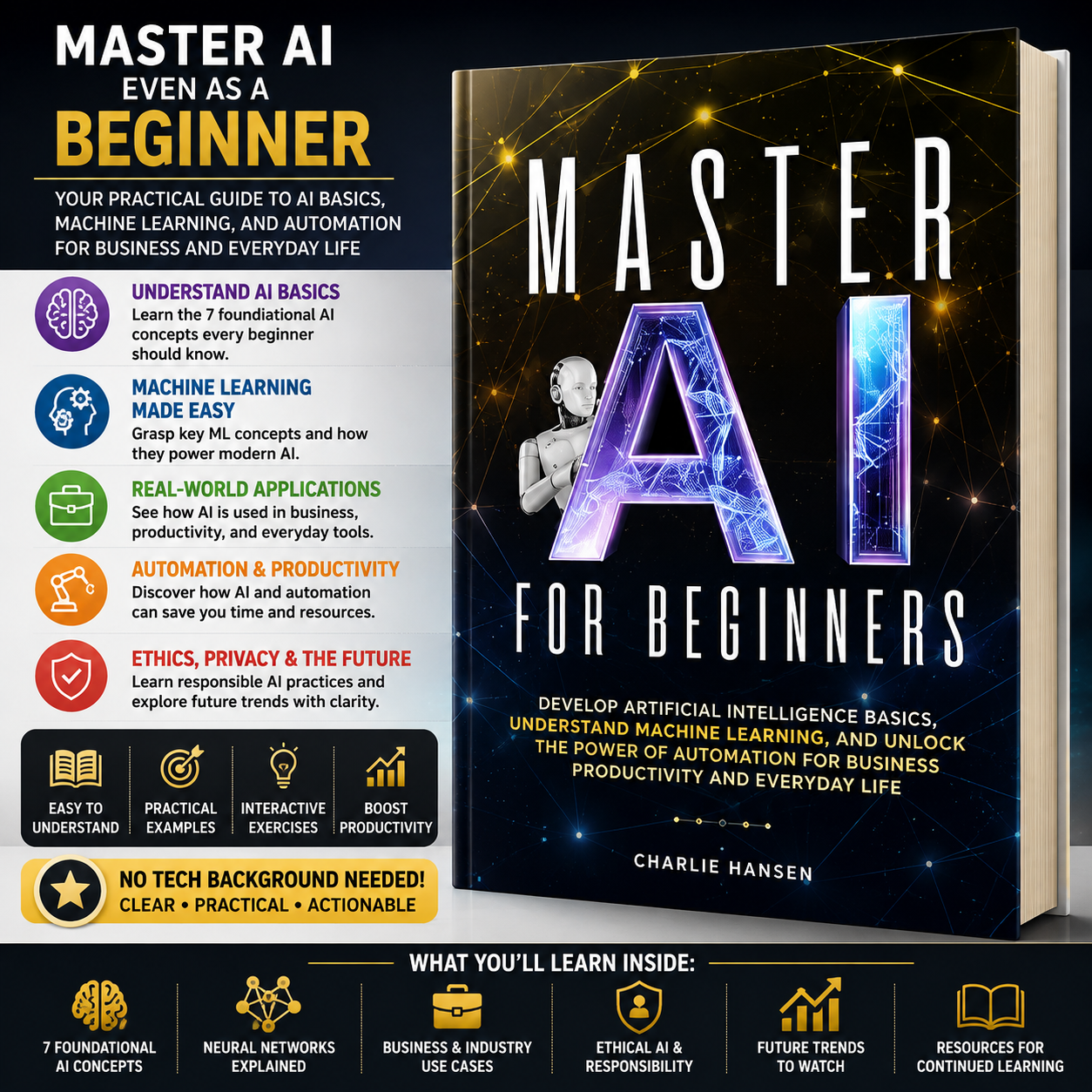
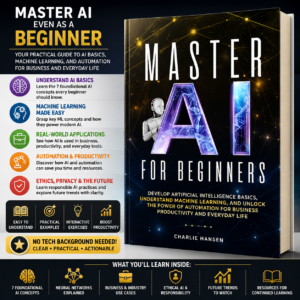
Master AI for Beginners: Develop Artificial Intelligence Basics, Understand Machine Learning, and Unlock the Power of Automation for Business Productivity, and Everyday Life by Charlie Hansen is designed as an introduction for readers who want to understand AI without starting with advanced programming or technical theory.
The book is Book 1 of The AI Success Series and focuses on AI fundamentals, practical applications, business productivity, automation, ethics, and the growing role of AI in everyday life.
What Is Master AI for Beginners About?
Master AI for Beginners is a beginner-oriented introduction to artificial intelligence.
The book is aimed particularly at people who may not have a technical background but want to understand how AI works and where it can be applied.
Rather than focusing primarily on programming, it introduces fundamental AI concepts and connects them to practical examples.
According to the book’s description, readers will explore topics including:
Fundamental AI concepts
Machine learning
Neural networks
AI applications in business
Automation
AI productivity
Ethical considerations
Privacy and bias
AI trends
Everyday uses of artificial intelligence
AI resources and continued learning
This makes the book more of an AI fundamentals and practical applications guide than a programming textbook.
Why Learn About AI?
Artificial intelligence is already present in many technologies people use regularly.
Recommendation systems, search engines, digital assistants, automated customer service, fraud detection, image recognition, and other applications can involve AI or machine learning.
Understanding the basic concepts behind these technologies can make it easier to understand discussions about AI and evaluate new tools as they become available.
You do not necessarily need to become an AI developer to benefit from understanding the fundamentals.
For many professionals, business owners, students, and general technology users, knowing what AI can and cannot do may simply help them make better decisions about when to use it.
AI Without a Programming Background
One of the main focuses of Master AI for Beginners is accessibility.
The book is written for readers who may have little or no experience with coding.
That makes it different from technical books that teach readers how to build machine learning models or develop AI applications from scratch.
Instead, the book introduces concepts progressively and uses practical examples to explain how AI can relate to business and everyday activities. Goodreads describes it as a guide designed specifically for readers without a technical background.
Understanding Artificial Intelligence
Before exploring advanced AI tools, it helps to understand what artificial intelligence actually means.
At its simplest level, AI refers to computer systems designed to perform tasks that normally require aspects of human intelligence.
Depending on the application, this can include activities such as:
Recognizing patterns
Processing language
Classifying information
Making predictions
Analyzing data
Generating content
Supporting decisions
The exact technology behind these capabilities can vary considerably.
A beginner therefore benefits from understanding the differences between broad AI concepts instead of treating every AI application as the same thing.
What Is Machine Learning?
Machine learning is an important area within artificial intelligence.
Instead of explicitly programming every possible rule, machine learning systems can be trained using data to identify patterns and make predictions or classifications.
For example, machine learning can be used in applications involving recommendations, image recognition, fraud detection, language processing, and many other tasks.
Master AI for Beginners introduces machine learning as part of its broader explanation of artificial intelligence, helping readers understand why machine learning has become such an important part of modern AI.
Neural Networks Explained for Beginners
Neural networks are another important concept in modern artificial intelligence.
The terminology can initially sound intimidating, particularly for someone without a computer science background.
A beginner-level explanation can help readers understand the basic idea without requiring them to immediately learn the mathematics behind neural network architectures.
The book includes an introduction to neural networks among its core AI concepts, making it part of the broader foundation it provides for new learners.
AI Applications in Business
One of the practical areas covered by the book is the use of AI in business.
Businesses can use artificial intelligence in many different ways depending on their industry and objectives.
Potential applications include:
Data analysis
Customer service
Automation
Marketing
Workflow optimization
Fraud detection
Forecasting
Research
Document processing
The important point is that AI should be considered according to a specific business need rather than adopted simply because it is a popular technology.
A useful AI implementation should solve a genuine problem or improve an existing process.
AI and Everyday Productivity
AI is not limited to large corporations.
Individuals can also encounter AI in everyday applications.
For example, AI-powered tools can assist with writing, information organization, research, recommendations, image generation, translation, and other digital tasks.
For beginners, understanding these applications can make the technology less abstract.
Instead of thinking about AI only as something used by technology companies, readers can begin to recognize how artificial intelligence is already integrated into many everyday services.
Understanding Automation
Automation is another important subject connected to AI.
Traditional automation can follow predefined rules, while AI-based systems can sometimes handle tasks involving patterns, language, predictions, or other forms of more complex input.
This distinction is useful for business owners and professionals considering automation.
Not every repetitive task requires artificial intelligence. Sometimes a simple automated workflow is enough.
Understanding the difference can help organizations choose technology based on the actual problem they are trying to solve.
AI Ethics, Privacy, and Bias
Learning about AI is not only about understanding its capabilities.
There are also important questions surrounding how AI should be used.
The book addresses ethical considerations, including issues involving privacy and bias.
These topics matter because AI systems can be influenced by the data and processes used to develop them.
For businesses and individuals, responsible AI use can include considering questions such as:
What data is being provided to an AI system?
Does the information contain sensitive material?
How reliable is the AI-generated result?
Could an automated decision unfairly affect someone?
Is human review necessary?
How should AI-generated information be verified?
These considerations become increasingly important as AI becomes part of everyday workflows.
What Can Beginners Learn From the Book?
The book’s description highlights several areas that beginners can explore, including seven foundational AI concepts, practical AI applications, machine learning, neural networks, ethical AI considerations, strategies for integrating AI into business processes, and future AI trends.
It also includes practical examples and interactive exercises intended to reinforce the concepts.
That structure can be useful for readers who prefer learning through examples rather than reading a highly theoretical introduction.
Is Master AI for Beginners a Programming Book?
No.
This is an important distinction.
If you are looking for a detailed Python course, machine learning programming tutorial, or technical guide to building AI models, this book is probably not the right type of resource.
It is better described as a beginner-friendly introduction to AI concepts and applications.
An independent review similarly noted that the book provides an introduction to AI, machine learning, business applications, and ethical considerations, while observing that readers looking specifically for hands-on instructions for using AI tools may want something more practical.
That is useful context when deciding whether the book matches your expectations.
Who Should Read Master AI for Beginners?
This book may be useful for:
AI beginners
Students
Business professionals
Entrepreneurs
Small business owners
Managers
Technology enthusiasts
Non-technical professionals
People interested in machine learning
Readers curious about AI and automation
It can be especially suitable for someone who wants to build a basic understanding of AI before moving into more specialized topics.
What I Like About the Beginner Focus
The strongest reason to consider this book is its accessibility.
AI can be difficult to approach when every explanation assumes that the reader already understands computer science.
A beginner-focused book can provide a more comfortable starting point by introducing concepts gradually.
The progression from fundamental AI concepts to machine learning, neural networks, automation, business applications, and ethical considerations gives readers several different perspectives on the technology.
What to Keep in Mind Before Buying
It is also worth being realistic about what the book offers.
The title uses the word “Master,” but no short introductory book can make someone an expert in artificial intelligence.
Readers should view this as a foundation rather than a complete professional AI education.
If your goal is to become a machine learning engineer, develop AI models, or build sophisticated AI applications, you will eventually need more specialized resources.
On the other hand, if your goal is simply to understand the fundamentals and become more comfortable discussing AI, this type of introductory book may be a reasonable starting point.
Book Details
Title:Master AI for Beginners: Develop Artificial Intelligence Basics, Understand Machine Learning, and Unlock the Power of Automation for Business Productivity, and Everyday Life
Author: Charlie Hansen
Series: The AI Success Series
Book: Book 1 of 3
Publication Date: April 17, 2025
Language: English
Format: Kindle Edition, with other editions potentially available
Length: 120 pages for the Kindle edition listed by Goodreads
Category: Artificial Intelligence, Machine Learning, Automation, Business Productivity
Audience: Beginners and non-technical readers
Where to Find Master AI for Beginners
If you want to explore the book and check the latest available formats and pricing, you can view the Amazon listing here:
Affiliate disclosure: This article contains an affiliate link. If you make a purchase through the link, the publisher of this website may receive a commission at no additional cost to you.
Final Thoughts
Artificial intelligence is becoming increasingly relevant to both professional and everyday life, but understanding AI does not require everyone to become a programmer.
Master AI for Beginners by Charlie Hansen provides an introduction to artificial intelligence, machine learning, neural networks, automation, business applications, and ethical considerations from a beginner-oriented perspective.
The book may be a good starting point for someone who wants to understand the basic ideas behind AI without immediately diving into advanced mathematics or programming.
At the same time, it is best viewed as an introductory resource, not a replacement for specialized technical training.
For readers searching for an AI book for beginners, artificial intelligence guide, machine learning introduction, AI automation book, non-technical AI book, or beginner guide to AI, this title is worth exploring.

 Artificial intelligence is becoming part of everyday technology, business, education, and professional work. Yet for someone who is completely new to AI, the subject can quickly become confusing.