 Artificial intelligence has become part of everyday life. From image generation and recommendation systems to language models such as ChatGPT, AI is increasingly involved in the technology people use every day.
But understanding how artificial intelligence actually works can be much more difficult than simply using an AI application.
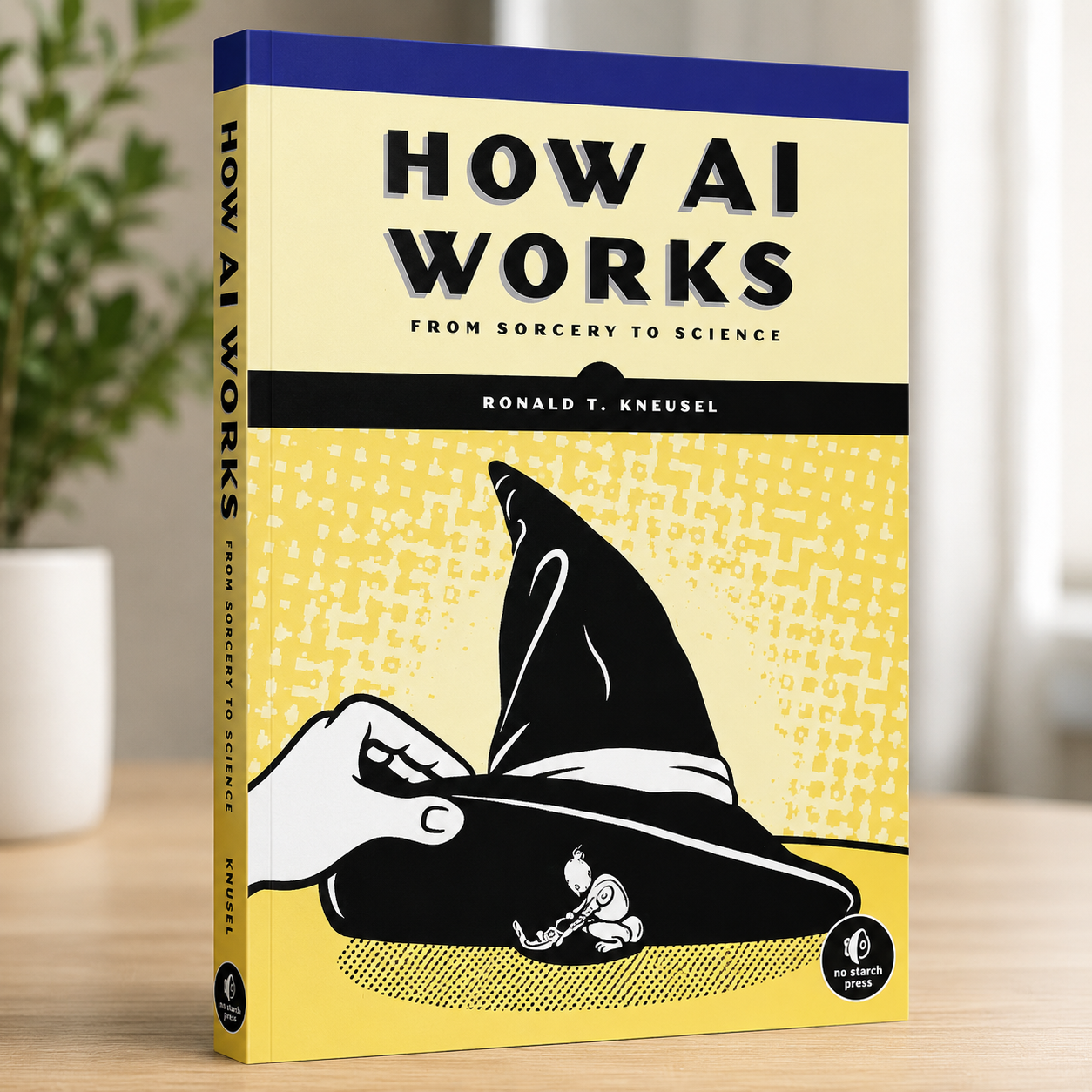
For readers who want to understand the concepts behind modern AI without starting with advanced mathematics, How AI Works: From Sorcery to Science by Ronald T. Kneusel offers an accessible introduction.
Published by No Starch Press in 2023, the book has 192 pages and covers the development of AI from classical machine learning to neural networks, generative AI, and large language models.
What Is How AI Works: From Sorcery to Science About?
How AI Works: From Sorcery to Science explains artificial intelligence from a conceptual perspective.
Rather than requiring readers to begin with complicated mathematical formulas, the book explores what AI is, how it developed, how machine-learning systems work, and why modern AI has become so capable.
The book covers topics including:
- Artificial intelligence
- Machine learning
- Deep learning
- Neural networks
- Convolutional neural networks
- Generative AI
- Large language models
- The history of AI
- The implications of modern AI
The publisher’s description specifically emphasizes explaining AI without unnecessary mathematical complexity or jargon.
Understanding the Difference Between AI, Machine Learning, and Deep Learning
One of the first things that can confuse beginners is the relationship between artificial intelligence, machine learning, and deep learning.
These terms are related, but they are not interchangeable.
Artificial intelligence is the broader field concerned with creating systems capable of performing tasks associated with intelligent behavior.
Machine learning is an approach in which systems learn patterns from data rather than relying entirely on manually written rules.
Deep learning is a branch of machine learning that uses neural networks with multiple layers.
Understanding this relationship provides a useful foundation for exploring modern AI.
A Look at the History of Artificial Intelligence
AI did not suddenly appear with ChatGPT or today’s generative AI tools.
The field has developed over many decades.
The book explores the history of artificial intelligence and explains why the current period of rapid AI development has emerged after years of research.
Its table of contents includes a dedicated section on the history of AI, followed by discussions of classical machine learning and neural networks.
This historical perspective can help readers understand why today’s AI systems are built differently from some of the earlier approaches to artificial intelligence.
What Are Neural Networks?
Neural networks are one of the fundamental technologies behind modern AI.
Inspired loosely by concepts associated with biological neural systems, artificial neural networks consist of interconnected computational units that process information.
During training, a neural network adjusts internal parameters based on data and an optimization process.
The book introduces neural networks as an important step in the evolution of modern AI and explains their role without requiring readers to begin with advanced mathematics.
How Does AI Learn From Data?
A common misconception is that AI simply “knows” information.
In reality, machine-learning systems are trained using data.
Depending on the system and learning approach, training can involve large collections of examples that allow a model to identify patterns.
For a neural network, training involves adjusting parameters so that the system becomes better at producing the desired outputs for the training task.
This basic concept is important for understanding why the quality, quantity, and characteristics of training data can matter.
Convolutional Neural Networks and Computer Vision
The book also discusses convolutional neural networks (CNNs).
CNNs became particularly important in computer vision because they can process spatial patterns in images.
Applications of computer vision can include:
- Image classification
- Object detection
- Image analysis
- Pattern recognition
- Medical imaging
Kneusel’s book includes a chapter titled “Convolutional Neural Networks: AI Learns to See.”
This gives readers an introduction to how neural-network techniques can be applied to visual information.
What Is Generative AI?
Generative AI represents another important development discussed in the book.
Instead of simply classifying or analyzing existing information, generative AI systems can produce new outputs based on patterns learned during training.
Depending on the system, generated content can include:
- Text
- Images
- Audio
- Code
- Other forms of digital content
The book includes a dedicated chapter called “Generative AI: AI Gets Creative.”
For readers who have encountered modern AI image or text-generation tools, this section provides useful background for understanding the technology at a conceptual level.
How Large Language Models Work
Another important topic is large language models (LLMs).
LLMs are the technology behind many modern AI assistants and text-generation systems.
The book discusses large language models and their implications, including systems such as ChatGPT and Bard.
Understanding LLMs can help explain why AI assistants can generate surprisingly coherent responses while also sometimes producing incorrect information.
An AI model can generate a plausible response without necessarily possessing human-like understanding or guaranteeing that every statement is factually correct.
That is why verification remains important when using AI-generated information.
Why Does AI Sometimes Make Mistakes?
AI systems can produce convincing answers that are nevertheless inaccurate.
This is one of the reasons it is important to understand AI as a computational system rather than treating it as an infallible source of information.
Factors such as training data, model architecture, statistical patterns, context, and the particular task can influence an AI system’s output.
For practical AI users, understanding these limitations is just as important as understanding the technology’s capabilities.
AI Without Complicated Mathematics
One of the strongest characteristics of How AI Works is its effort to explain AI concepts without requiring readers to begin with complex mathematical equations.
The publisher describes the book as a guide for a broad audience interested in understanding how AI works without having to read a traditional textbook.
That makes the book potentially useful for readers who are curious about AI but do not have a formal background in computer science.
What Can Readers Learn From the Book?
The book’s contents provide a progression through several major areas of artificial intelligence:
- AI overview
- History of AI
- Classical machine learning
- Neural networks
- Convolutional neural networks
- Generative AI
- Large language models
- The broader implications of AI
It also includes a glossary, resources, and an index.
This structure makes it possible for readers to move from fundamental concepts toward more recent developments.
Who Is This Book For?
How AI Works: From Sorcery to Science may be useful for:
- AI beginners
- Technology enthusiasts
- Students
- Educators
- Business professionals
- Content creators
- Writers
- Researchers
- Readers interested in ChatGPT
- People curious about machine learning
- Anyone who wants to understand AI at a conceptual level
It can also be useful for people who already use AI tools but want to understand more about the technology behind them.
Is How AI Works a Programming Book?
Not primarily.
The book focuses on understanding artificial intelligence rather than teaching readers how to build a complete AI application.
That distinction makes it different from programming-focused books about Python, machine learning frameworks, or deep-learning implementation.
If your goal is to understand what AI is, how it developed, and how major AI technologies work conceptually, this book is more closely aligned with that goal.
About Ronald T. Kneusel
Ronald T. Kneusel is a data scientist and author with a background in machine learning and deep learning.
Google Books describes him as a data scientist who builds deep-learning systems, with experience in medical imaging and medical-device development. He earned a PhD in machine learning from the University of Colorado, Boulder, and has extensive experience in the field.
His background gives the book a technical foundation while its intended presentation remains accessible to a general audience.
Book Details
Title: How AI Works: From Sorcery to Science
Author: Ronald T. Kneusel
Publisher: No Starch Press
Publication: October 24, 2023
Length: 192 pages
Language: English
ISBN-10: 1718503725
ISBN-13: 9781718503724
Category: Computers → Artificial Intelligence
Main Topics: Artificial Intelligence, Machine Learning, Deep Learning, Neural Networks, Generative AI, Large Language Models
These bibliographic details are supported by Google Books, the publisher’s promotional material, and library catalog records.
Where to Buy How AI Works: From Sorcery to Science
If you want to check the current Amazon listing, available formats, and pricing, you can visit the product page below:
Check How AI Works: From Sorcery to Science on Amazon
Affiliate disclosure: This article contains an affiliate link. If you make a qualifying purchase through the link, the publisher of this website may receive a commission at no additional cost to you.
Final Thoughts
How AI Works: From Sorcery to Science is aimed at readers who want to understand artificial intelligence without immediately diving into advanced mathematics or highly technical terminology.
Its coverage moves from the history of AI and classical machine learning to neural networks, computer vision, generative AI, and large language models.
For someone who regularly uses ChatGPT or other AI tools but has wondered what is happening “under the hood,” this book provides a useful conceptual starting point.
It is not presented as a shortcut to becoming an AI engineer. Instead, its value is in helping readers build a clearer understanding of the technology they are already encountering.