 Artificial intelligence is becoming increasingly relevant in education.
Teachers are already exploring AI for lesson planning, writing classroom materials, organizing information, creating differentiated activities, and handling some of the administrative work that comes with teaching.
But learning how to use AI effectively in a classroom can be challenging.
Teachers need to think about more than productivity. They also have to consider student privacy, accuracy, academic integrity, age-appropriate use, and the role of professional judgment.
Classroom AI Made Simple: A Teacher’s Roadmap to Effective Technology Integration by Alice Herz takes a practical approach to these challenges.
The book is designed for educators who want to understand how AI can fit into their existing teaching workflows without allowing technology to replace the human side of education.
What Is Classroom AI Made Simple About?
Classroom AI Made Simple is a practical guide for teachers interested in incorporating artificial intelligence into their work.
Rather than treating AI as a purely technical subject, the book focuses on classroom applications.
The topics highlighted in the book include:
- AI-assisted lesson planning
- Prompt writing for educators
- Differentiating instruction
- Reading-level support
- Math activities
- Parent communication
- Behavior documentation
- AI implementation in K–12 education
- Academic integrity
- Student data privacy
- Responsible AI use
- Practical classroom workflows
The overall goal is to help teachers understand where AI may be useful while maintaining professional judgment.
Why Are Teachers Interested in AI?
Teaching involves much more than standing in front of a classroom.
Educators often spend considerable time preparing lessons, adapting materials, communicating with parents, documenting student behavior, and organizing resources.
AI tools can potentially assist with some of these tasks.
For example, a teacher might use an AI system to help create an initial lesson outline or generate different versions of an activity.
The teacher can then review, modify, and adapt the material to fit the actual students in the classroom.
This distinction is important.
AI can assist the teacher, but it does not know every student’s needs, classroom dynamics, school policies, or professional responsibilities.
AI-Assisted Lesson Planning
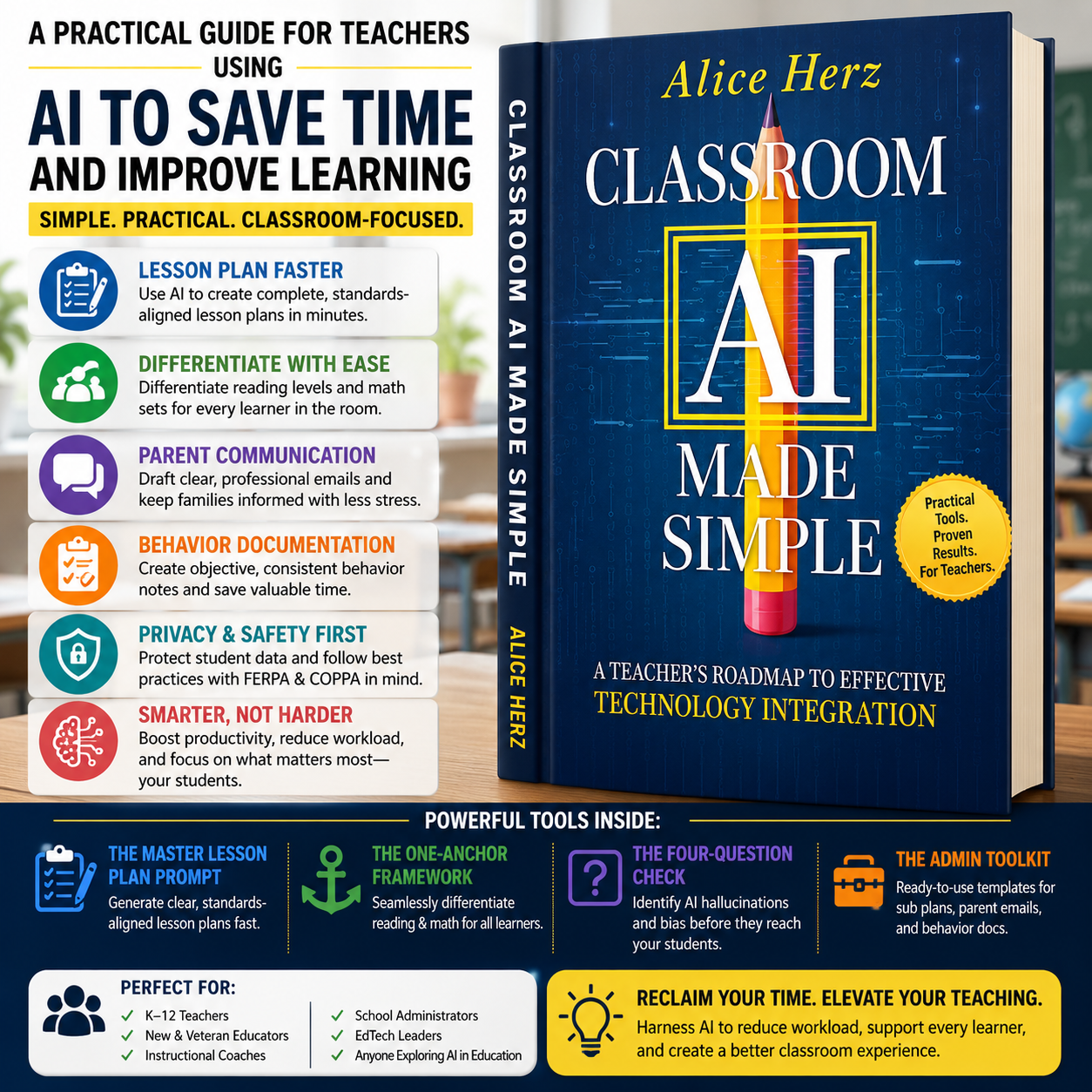
One of the book’s highlighted concepts is the Master Lesson Plan Prompt.
The idea is to use a structured prompt to help create a first draft of a lesson plan.
A teacher might provide information such as:
- Grade level
- Subject
- Learning objectives
- Standards
- Lesson duration
- Student needs
- Available materials
- Assessment requirements
AI can then potentially produce a structured starting point.
The teacher can review the result and make the necessary adjustments.
This approach may be particularly useful for brainstorming and creating a first draft rather than treating the AI output as a finished lesson plan.
Differentiating Instruction With AI
Students do not always learn at the same pace or in the same way.
Teachers may therefore need to adapt activities and explanations for different learners.
AI can potentially help generate variations of an activity.
For example, a teacher could ask for:
- A simpler explanation
- Additional practice questions
- Extension activities
- Alternative examples
- Different reading levels
- Additional discussion questions
The teacher still needs to determine whether the generated material is appropriate for the students.
This makes AI potentially useful as an instructional assistant, rather than a replacement for the teacher.
The One-Anchor Framework
Another concept highlighted in the book is the One-Anchor Framework.
According to the book description, this framework is intended to provide a way of differentiating reading levels and math sets for learners.
Differentiation can be time-consuming because teachers need to maintain the same core learning objective while adjusting the difficulty or presentation.
A structured framework can potentially make this process more manageable.
However, teachers should always consider the actual needs of their students rather than relying on a generic AI-generated differentiation strategy.
AI for Parent Communication
Teachers also spend time communicating with parents and guardians.
AI can potentially help create a first draft of a parent email or communication.
For example, a teacher might provide the basic facts and ask AI to organize them into a clear, professional message.
This can be useful when a teacher wants help with wording.
However, sensitive information about students should be handled carefully.
Teachers should follow their school’s policies and applicable privacy requirements before entering student information into any external AI service.
The Four-Question Check
The book also introduces a Four-Question Check designed to help educators identify potential AI hallucinations and bias before information reaches students.
This is an important concept because generative AI can produce information that sounds convincing but is inaccurate.
Before using AI-generated educational material, teachers can consider questions such as:
- Is the information factually accurate?
- Does it match the learning objective?
- Is the material appropriate for the students?
- Does it contain potential bias or misleading information?
The exact evaluation process will vary depending on the subject and context.
AI Hallucinations in Education
One of the biggest concerns when using generative AI in education is the possibility of inaccurate information.
An AI system can sometimes generate a response that appears authoritative even though parts of it are incorrect.
For educators, this creates an additional responsibility.
AI-generated lesson materials, historical information, scientific explanations, mathematical examples, and other educational content should be reviewed before being presented to students.
Teachers remain responsible for the accuracy and suitability of classroom materials.
Student Privacy and AI
Privacy is particularly important in education.
Student information can include personal, academic, behavioral, or other sensitive data.
Teachers should therefore avoid casually entering identifiable student information into AI tools.
The book specifically addresses student data privacy and references frameworks such as FERPA and COPPA in its description.
The exact legal requirements can depend on the jurisdiction, school, technology provider, and circumstances, so educators should also follow their institution’s policies and applicable laws.
AI and Academic Integrity
Artificial intelligence has also created new questions about academic integrity.
Students can potentially use AI to generate text, answer questions, summarize material, or assist with assignments.
That creates challenges for educators.
Instead of treating AI only as a problem, teachers may need to consider how assignments and classroom activities can be designed in an environment where AI tools exist.
This could include emphasizing:
- Original thinking
- Classroom discussion
- Process-based assignments
- Oral explanations
- Source evaluation
- Critical thinking
- Transparent AI use where appropriate
The appropriate approach will depend on the age of students and the policies of the school or institution.
AI Should Support Teachers, Not Replace Them
Perhaps the most important idea behind an educator-focused AI guide is that technology should remain a tool.
Teachers provide things that AI cannot simply reproduce through a prompt.
They understand their students, classroom environment, school culture, relationships, and individual circumstances.
AI can potentially assist with drafting and organizing information, but teachers still provide the professional judgment needed to decide what belongs in a classroom.
Who Is This Book For?
Classroom AI Made Simple may be useful for:
- K–12 teachers
- New educators
- Experienced teachers
- School administrators
- Instructional coaches
- Educational technology professionals
- Teachers exploring generative AI
- Educators interested in prompt engineering
- Teachers looking for practical AI workflows
The book appears particularly relevant to educators who are interested in AI but do not want to start with highly technical explanations.
Is Classroom AI Made Simple a Technical AI Book?
No.
This is not a programming textbook or a machine-learning engineering manual.
You do not need to learn Python, neural-network mathematics, or AI model development to understand the book’s intended applications.
Its focus is on technology integration in education.
That makes it more relevant to teachers who want to understand how AI can be incorporated into lesson preparation and other classroom-related tasks.
What Makes the Book Different?
The focus on the teacher’s actual workflow is one of the most interesting aspects of the book.
Instead of discussing AI only in abstract terms, the book presents specific areas where educators may encounter practical challenges.
These include:
- Planning lessons
- Differentiating instruction
- Communicating with parents
- Documenting behavior
- Checking AI-generated information
- Protecting student information
- Maintaining academic integrity
This practical perspective can make the subject easier to understand for teachers who are just beginning to explore AI.
A Practical Approach to AI Integration
AI integration does not have to mean changing everything about the way a teacher works.
A more realistic approach may be to start with one specific task.
For example:
Step 1: Choose a repetitive task.
Step 2: Determine whether AI can assist with it.
Step 3: Create a clear prompt.
Step 4: Review the AI output.
Step 5: Edit and adapt the result.
Step 6: Evaluate whether the process actually saves time or improves the workflow.
This approach allows educators to experiment without assuming that AI is appropriate for every part of teaching.
About Alice Herz
Alice Herz is the author of Classroom AI Made Simple.
The book presents her perspective as an educator with extensive classroom experience and focuses on practical AI integration for teachers.
The description emphasizes the perspective of someone who understands the everyday workload involved in teaching rather than approaching AI solely from a technology perspective.
Book Details
Title: Classroom AI Made Simple: A Teacher’s Roadmap to Effective Technology Integration
Author: Alice Herz
Format: Kindle Edition
Language: English
Genre: Non-Fiction
Category: Education / Educational Technology / Artificial Intelligence
Audience: K–12 Teachers and Educators
Main Topics: AI in Education, Lesson Planning, Prompt Engineering, Differentiated Instruction, Student Privacy, Academic Integrity, Educational Technology
Where to Find Classroom AI Made Simple
If you are a teacher or educator interested in exploring practical applications of artificial intelligence in education, you can check the current Amazon listing here:
👉 Check Classroom AI Made Simple by Alice Herz on Amazon
Affiliate disclosure: This article contains an affiliate link. If you make a purchase through the link, the publisher of this website may receive a commission at no additional cost to you.
Final Thoughts
Artificial intelligence is likely to remain an important topic in education, but using it effectively requires more than knowing how to generate a response.
Teachers need to understand how to write useful prompts, evaluate AI-generated information, protect student privacy, and maintain professional judgment.
Classroom AI Made Simple by Alice Herz focuses on these practical considerations from an educator’s perspective.
The book may be particularly useful for teachers who are curious about AI but want a practical starting point rather than a technical computer-science textbook.
For readers searching for an AI book for teachers, AI in education guide, ChatGPT for teachers, educational technology book, AI lesson planning guide, prompt engineering for educators, or artificial intelligence in K–12 education, this title is worth exploring.