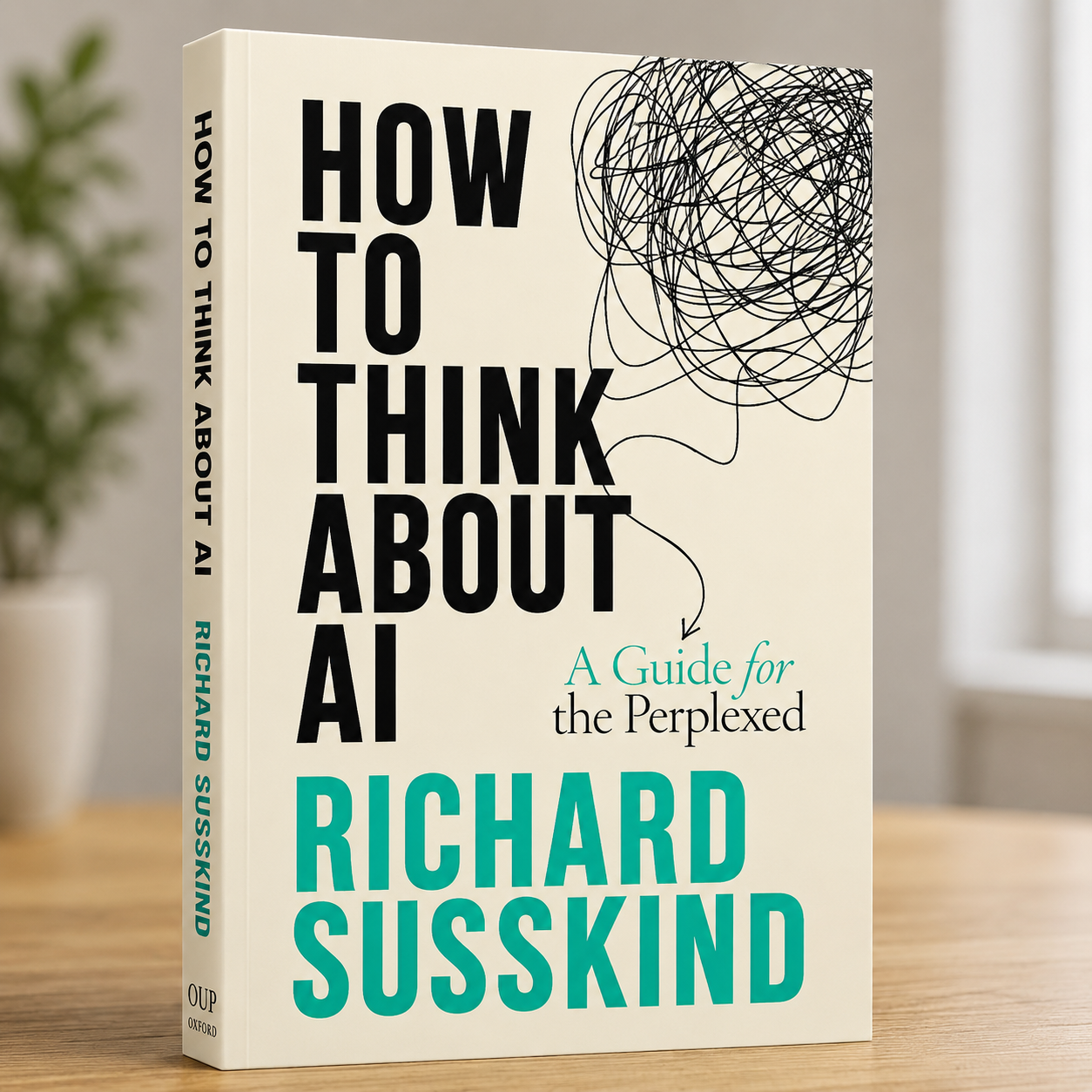
How to Think About AI by Richard Susskind: A Practical Guide to Understanding Artificial Intelligence
Artificial intelligence has moved from research laboratories into everyday life.
People now encounter AI in search engines, workplace software, creative tools, customer-service systems, recommendation platforms, and generative AI applications. Yet using AI and understanding what AI means for society are two very different things.
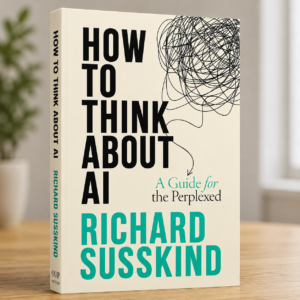
For readers who want to explore the bigger questions surrounding artificial intelligence without studying computer science, How To Think About AI: A Guide For The Perplexed by Richard Susskind offers a non-technical introduction to the subject.
Published by Oxford University Press in 2025, the book examines the development of AI, its practical applications, potential risks, and possible future implications.
What Is How To Think About AI About?
How To Think About AI is not a programming manual or a step-by-step guide to building an AI model.
Instead, Richard Susskind looks at artificial intelligence from a broader perspective.
The book asks readers to consider questions such as:
What exactly is artificial intelligence?
What can today’s AI systems actually do?
Why has AI developed so rapidly?
How might AI change professional work?
What risks should society consider?
How should AI be regulated?
Could future machines become conscious?
How might AI affect human identity and society?
Oxford Academic describes the book as a short, non-technical guide intended to help readers think differently about AI and its impact on humanity.
A Non-Technical Introduction to Artificial Intelligence
One of the most appealing aspects of the book is that readers do not need to be AI engineers or computer scientists.
The discussion focuses more on ideas, consequences, and ways of thinking about AI than on programming syntax or mathematical formulas.
This makes the book potentially useful for readers who regularly encounter AI but want a broader understanding of the technology.
It is particularly relevant at a time when conversations about AI often become divided between extreme optimism and extreme pessimism.
Susskind instead examines both opportunities and risks and encourages readers to think carefully about what AI could mean for society.
Understanding the History of AI
Artificial intelligence did not begin with ChatGPT.
The field has been developing for decades, with researchers exploring machine intelligence long before today’s generative AI systems appeared.
Susskind draws on his experience of working on AI since the early 1980s and places current developments within the longer history of artificial intelligence.
This historical perspective is useful because it puts today’s AI developments into context.
ChatGPT and generative AI are important developments, but they are part of a much longer story involving different approaches to machine intelligence.
AI Is More Than ChatGPT
For many people, artificial intelligence became much more visible after the rapid adoption of generative AI tools.
However, AI includes much more than chatbots.
Artificial intelligence can involve areas such as:
Machine learning
Computer vision
Natural language processing
Recommendation systems
Robotics
Automated decision systems
Generative AI
Large language models
Susskind’s approach encourages readers to look beyond today’s most popular AI applications and consider how future technologies could potentially affect society.
How AI Could Change Work
One of the important themes in How To Think About AI is the relationship between artificial intelligence and professional work.
AI can already assist with many tasks involving information, communication, analysis, and content generation.
However, the effect of AI on work is not necessarily as simple as “AI replaces humans.”
Some tasks may become automated.
Other tasks may change.
New types of work may emerge.
And some professions may need to reorganize how people and AI systems work together.
The book’s structure includes chapters on automation, innovation, elimination, and radical structural change, showing that the author considers AI’s effects on work at a broader organizational level.
Automation, Innovation, and Elimination
Automation is often discussed as though its only consequence is job replacement.
The reality can be more complicated.
When a task becomes automated, organizations may use the resulting capability in different ways.
They might:
Reduce manual work
Increase productivity
Change existing processes
Create new services
Redesign professional roles
Shift human attention toward different activities
The book explores these possibilities through its discussion of automation, innovation, and elimination.
This perspective can be useful for business owners and professionals trying to understand AI beyond the simple question of whether a particular job will disappear.
Why We Need to Think Differently About AI
AI can create confusion because people often compare machines directly with humans.
For example, someone might ask whether an AI system is “intelligent” in exactly the same sense that a human is intelligent.
But machine systems can have capabilities that do not correspond neatly to human abilities.
Susskind encourages readers to reconsider some of the assumptions people make when discussing artificial intelligence.
This is one reason the book focuses on how to think about AI, rather than simply explaining how AI technologies work.
The Benefits and Risks of AI
Artificial intelligence has potential applications across many areas.
AI can assist with tasks involving:
Information processing
Research
Communication
Data analysis
Automation
Creative work
Professional services
At the same time, AI introduces legitimate concerns.
These can include:
Privacy
Security
Bias
Employment disruption
Accountability
Regulation
Misuse
Dependence on automated systems
The book dedicates an entire section to confronting the risks of AI, including categories of risk and approaches to harnessing the technology.
AI Regulation and Moral Questions
As AI becomes more capable, governments, businesses, researchers, and the public face questions about how these systems should be governed.
For example:
Who should be responsible when an AI-assisted system causes harm?
What information should an AI system be allowed to access?
How much human oversight should be required?
Which applications should be restricted?
These questions cannot be answered solely through computer science.
They involve law, economics, ethics, public policy, and social values.
Susskind discusses the need to consider regulation and moral boundaries when thinking about the future of AI.
Could Machines Become Conscious?
One of the more speculative subjects addressed by the book is the possibility of conscious machines.
This is an extremely complex philosophical and scientific question.
Current AI systems can produce sophisticated outputs, but that does not establish that they possess human-like consciousness or subjective experience.
The book does not treat this as a settled question. Instead, it explores the possibility as part of a broader discussion about where AI could eventually lead.
Oxford Academic lists “Conscious Machines?” as one of the chapters in the book’s final section on the future.
AI and Human Identity
As AI becomes more capable, another question becomes increasingly interesting:
What makes humans different from machines?
If machines become capable of performing more intellectual and creative tasks, society may need to reconsider how it defines expertise, creativity, judgment, and intelligence.
Susskind connects these technological developments to broader questions about human identity and the future of humanity.
This does not mean that current AI systems are equivalent to people.
Rather, it highlights why technological progress can lead to philosophical questions that cannot be answered simply by looking at software capabilities.
Brain-Computer Interfaces and Virtual Reality
The book also looks beyond today’s familiar AI applications.
One of its future-oriented discussions considers technologies such as brain-computer interfaces (BCIs) and virtual reality.
These technologies could potentially change how people interact with computers and digital environments.
The book discusses possibilities involving brain signals, machine interaction, virtual worlds, privacy, and identity.
These are future-oriented topics, so they should be understood as possibilities and questions for consideration rather than guaranteed predictions.
Looking Beyond Today’s Technology
One of Susskind’s broader arguments is that discussions about AI should not focus exclusively on the tools available today.
Technology continues to evolve.
A system that seems advanced today may eventually become just one step in a much longer technological progression.
The author therefore encourages readers to think about technologies that have not yet been invented and how they could potentially affect society in the future.
This makes the book particularly interesting for readers who enjoy thinking about long-term technological change.
Five Main Parts of the Book
Oxford Academic organizes the book into five major sections:
Part One: Understanding AI
This section introduces artificial intelligence and examines its development and relationship with technology.
Part Two: Thinking Differently
Here, Susskind explores different ways of thinking about AI, including process-thinking, outcome-thinking, and common areas of confusion.
Part Three: Making AI Work
This section examines practical implications, including automation, innovation, and structural change.
Part Four: Confronting the Risks
The discussion moves toward risks associated with increasingly capable AI and ways of managing them.
Part Five: Contemplating the Future
The final section explores future possibilities, including conscious machines and other technological developments.
Who Should Read How To Think About AI?
The book may be suitable for readers who are interested in:
Artificial intelligence
ChatGPT and generative AI
Technology and society
The future of work
AI ethics
AI regulation
Automation
Digital transformation
Human-computer interaction
The philosophy of technology
It can also be useful for readers who do not have a technical background but want to participate more confidently in conversations about AI.
Is This an AI Programming Book?
No.
How To Think About AI is fundamentally a non-technical discussion of artificial intelligence.
If you are looking for a Python tutorial, machine-learning programming course, or technical guide to building neural networks, this is probably not the right type of book.
Instead, it is aimed at understanding the broader meaning and consequences of AI.
That distinction is important.
About Richard Susskind
Richard Susskind is a British author and technology expert who has worked on artificial intelligence and technology for decades.
Oxford University Press identifies him as the Special Envoy for Justice and AI to the Secretary-General of the Commonwealth. He is also President of the Society for Computers and Law and served as Technology Adviser to the Lord Chief Justice of England and Wales from 1998 to 2023.
His professional background includes extensive work at the intersection of technology, law, and professional services.
He also wrote his doctorate on AI and law at Balliol College, Oxford.
Book Details
Title:How To Think About AI: A Guide For The Perplexed
Affiliate disclosure: This article contains an affiliate link. If you make a qualifying purchase through the link, the publisher of this website may receive a commission at no additional cost to you.
Final Thoughts
How To Think About AI: A Guide For The Perplexed by Richard Susskind is aimed at readers who want to understand artificial intelligence from a broader perspective.
Rather than teaching readers how to program an AI model, the book examines what AI is, how it is changing work and society, what risks it creates, and what future developments could mean for humanity.
Its non-technical approach makes it potentially accessible to readers who are curious about AI but do not have a computer-science background.
The book also avoids treating the future of AI as a simple story of either guaranteed progress or inevitable disaster. Instead, it encourages readers to consider both possibilities and uncertainties.
For anyone searching for an AI book for beginners, artificial intelligence book, AI ethics book, AI and society book, future of AI book, AI regulation book, AI and the future of work book, or non-technical AI guide, How To Think About AI offers a thoughtful introduction to the larger questions surrounding this rapidly developing technology.

 Artificial intelligence has moved from research laboratories into everyday life.