AI for Good by Josh Tyrangiel: How Real People Are Using AI to Solve Real-World Problems
Artificial intelligence is often discussed in extremes.
Some people see AI as a technology that could transform almost everything, while others focus on its risks and potential negative consequences.
But there is another way to look at artificial intelligence: how are ordinary people and organizations actually using it to solve practical problems?
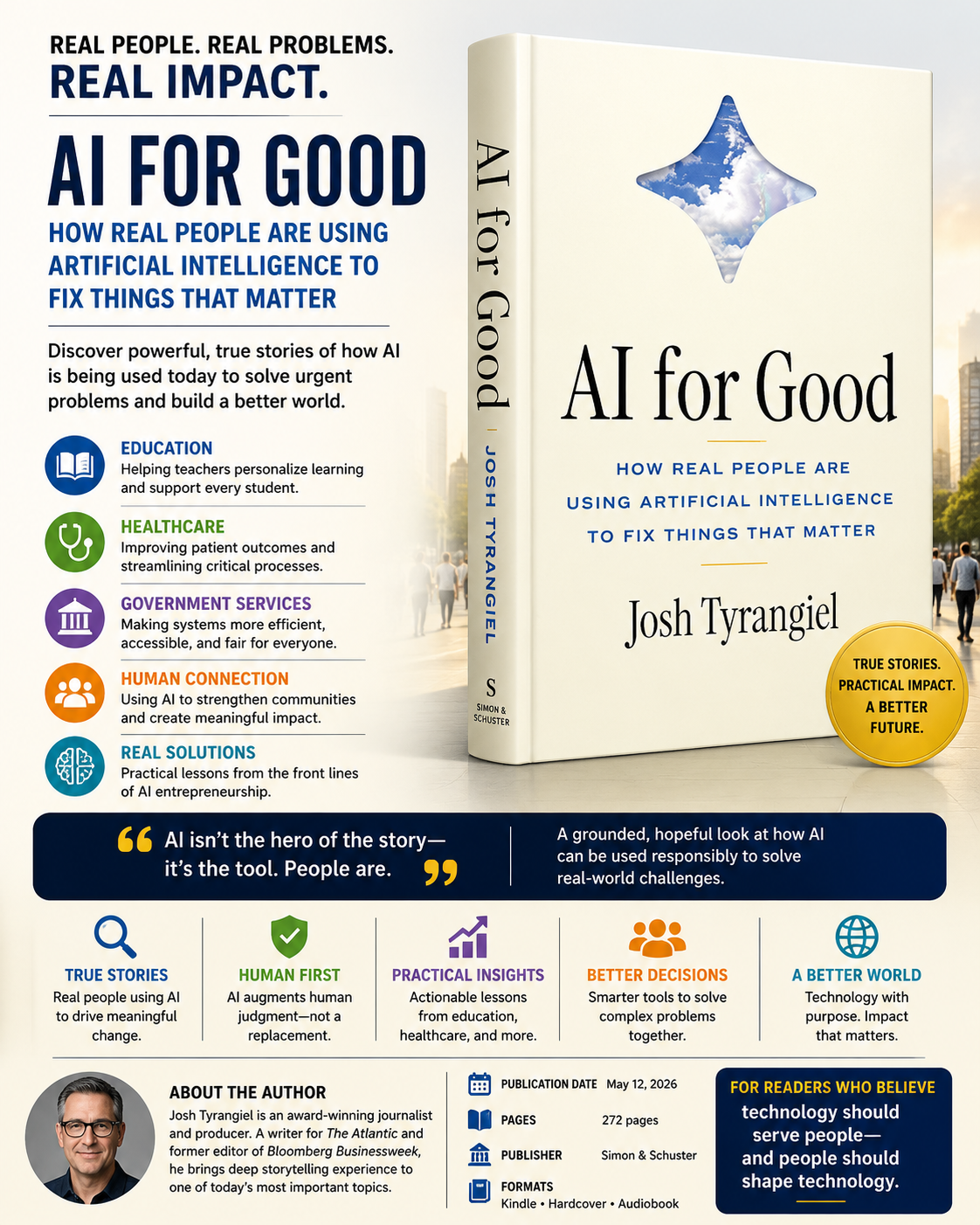
That is the central question explored in AI for Good: How Real People Are Using Artificial Intelligence to Fix Things That Matter by Josh Tyrangiel.
Published by Simon & Schuster in 2026, the 272-page book looks beyond the loudest AI debates and examines real-world applications in areas including education, healthcare, government services, and human connection.
What Is AI for Good About?
AI for Good explores how artificial intelligence is being used by people working on practical problems.
Rather than focusing primarily on famous technology executives or futuristic predictions, Josh Tyrangiel follows people who are using AI in specific areas where they are trying to improve existing systems and solve tangible challenges.
The book examines AI applications involving:
Education
Healthcare
Government services
Public-sector work
Human connection
Machine learning
AI-assisted problem solving
Technology and society
Practical AI implementation
The publisher describes these people as pragmatic users of AI who are attempting to make existing systems work better rather than simply pursuing technological novelty.
AI Beyond the Hype
One of the most interesting aspects of AI for Good is its attempt to move away from the usual arguments surrounding artificial intelligence.
AI discussions often focus on two extremes: enormous economic opportunities or catastrophic risks.
Tyrangiel takes a different approach.
Instead of asking only what AI might do in the distant future, the book asks what people are already doing with AI today.
That makes the book particularly relevant to readers who want to understand the practical side of artificial intelligence.
AI as a Tool, Not the Hero
A recurring idea in the book is that AI itself is not necessarily the most important part of the story.
People still identify the problems, make decisions, manage organizations, and determine how technology should be used.
AI can become a tool within that process.
The publisher uses the example of COVID-19 vaccine distribution to illustrate this point. AI helped process and standardize large amounts of logistical information, but the technology was part of a much larger human-led effort.
This distinction is important.
It suggests that successful AI adoption is not simply about having access to sophisticated software.
It is also about understanding the problem that needs to be solved.
AI in Education
Education is one of the areas examined in AI for Good.
Schools and educators are exploring AI for different purposes, including learning support, tutoring, information processing, and administrative tasks.
One example discussed in the book involves AI being used in educational settings to support teachers and students.
The broader lesson is that AI can potentially assist educators, but the technology does not eliminate the need for teachers.
Human judgment remains important when deciding whether AI-generated information is accurate, appropriate, and useful for students.
The book therefore presents AI as something that can potentially augment human work rather than simply replace it.
AI in Healthcare
Healthcare is another important area explored by Tyrangiel.
AI can potentially assist medical professionals with tasks involving large amounts of information, pattern recognition, imaging, documentation, and other processes.
However, healthcare is also an area where accuracy and oversight are especially important.
A useful AI system does not automatically replace doctors or other healthcare professionals.
Instead, AI can potentially provide additional information or assistance while qualified professionals remain responsible for interpretation and decisions.
This idea of keeping humans involved is one of the broader themes surrounding the book.
AI and Government Services
Government agencies often deal with large amounts of information and complicated administrative systems.
That makes government another area where AI may have practical applications.
Potential uses can include:
Processing information
Organizing data
Improving administrative workflows
Supporting public services
Translating information
Helping employees work with large datasets
But implementing AI within government is not always straightforward.
Institutions have existing rules, procedures, technology systems, and stakeholders.
The book explores these challenges rather than presenting AI adoption as an effortless process.
Keeping Humans in the Loop
One of the most important ideas connected to AI for Good is the importance of human oversight.
The Aspen Institute’s discussion with Tyrangiel highlighted two conditions he sees as important for effective AI integration: AI should augment rather than replace human judgment, and systems should allow people to maintain oversight of their outputs.
This is especially important in areas such as healthcare, education, and government.
AI can produce useful recommendations or information, but people need to determine whether those results are appropriate.
AI Does Not Automatically Solve Problems
It can be tempting to think that introducing AI into an organization will automatically improve its performance.
Reality is more complicated.
Organizations may face:
Outdated systems
Limited budgets
Resistance to change
Training requirements
Data-quality problems
Privacy concerns
Regulatory requirements
Organizational culture issues
Technology is only one part of the solution.
The book emphasizes the practical and sometimes difficult process of integrating AI into real institutions. Kirkus similarly describes the book as an exploration of organizations and professionals attempting to gain practical benefits from AI while dealing with institutional challenges.
AI Entrepreneurship
The book also introduces the idea of a new type of AI entrepreneurship.
This does not necessarily mean creating the next major technology company.
Instead, it can refer to people who recognize a specific problem and experiment with AI as part of a solution.
For example, someone working in education might identify a repetitive administrative problem and explore whether AI can reduce some of that workload.
A doctor might investigate whether AI can assist with a particular information-processing task.
A government employee might explore ways to make a complicated public-service process more efficient.
In each case, the starting point is the problem, not the technology.
Why Real-World Examples Matter
One advantage of studying real-world AI applications is that they provide more context than simply reading about technical capabilities.
It is easy to say that AI can analyze information or generate text.
It is more useful to understand how someone actually applies those capabilities to a specific problem.
The book’s case studies cover areas such as education, healthcare, and government, giving readers examples of how AI is being explored outside the technology industry.
Is AI for Good a Technical AI Book?
No.
This is not a programming manual.
Readers do not need advanced knowledge of Python, machine learning mathematics, or AI model development to understand the main ideas.
Instead, AI for Good is closer to a technology, society, and practical artificial intelligence book.
It focuses on people, organizations, problems, and the process of applying AI.
That makes it suitable for readers who are interested in the broader implications of AI rather than the technical process of building AI models.
Who Should Read AI for Good?
The book may appeal to:
Business professionals
Entrepreneurs
Technology enthusiasts
Educators
Healthcare professionals
Government workers
Policy researchers
AI-curious readers
Students
Readers interested in technology and society
People interested in practical AI applications
It may be especially interesting for readers who want to move beyond discussions about AI tools and learn about how AI is being used in real organizations.
What Makes AI for Good Different?
The book’s main distinction is its focus on practical implementation.
Instead of presenting AI as a magical solution, Tyrangiel examines people who are experimenting with the technology in complicated real-world environments.
The book acknowledges that change can be slow and that success is not guaranteed.
That makes the discussion more realistic.
AI may provide useful capabilities, but organizations still need people who understand the problem, evaluate the results, and manage the implementation.
About the Author
Josh Tyrangiel is a journalist and producer.
He is a writer for The Atlantic and previously served as editor of Bloomberg Businessweek and chief content officer of Bloomberg Media.
He also created Vice News Tonight on HBO and has produced documentaries for HBO, Netflix, and Apple TV. The publisher notes that he is a twelve-time Emmy and Peabody Award-winning producer.
His journalism background helps explain the book’s emphasis on people and real-world stories rather than technical AI theory.
Book Details
Title:AI for Good: How Real People Are Using Artificial Intelligence to Fix Things That Matter
Author: Josh Tyrangiel
Publisher: Simon & Schuster
Publication Date: May 12, 2026
Length: 272 pages
Language: English
Format: Kindle, Hardcover, eBook, and Audiobook editions are available depending on market.
Category: Artificial Intelligence / Technology & Society / Social Impact of AI
Main Topics: AI in Education, Healthcare AI, Government Technology, Human-AI Collaboration, AI Entrepreneurship, Artificial Intelligence and Society
Where to Buy AI for Good
If you are interested in learning about practical applications of artificial intelligence and how people are using AI to address real-world problems, you can check the current Amazon listing here:
Affiliate disclosure: This article contains an affiliate link. If you make a purchase through the link, the publisher of this website may receive a commission at no additional cost to you.
Final Thoughts
AI for Good by Josh Tyrangiel offers a different perspective on artificial intelligence.
Instead of concentrating entirely on futuristic predictions, the book looks at people who are already experimenting with AI to address practical challenges in areas such as education, healthcare, government, and human connection.
One of the most useful ideas is that AI does not have to replace people to be valuable.
In many situations, the more realistic goal may be to use AI to support human judgment, reduce certain kinds of repetitive work, and help people deal with complex information.
At the same time, the book recognizes that successful implementation is difficult and that technology alone cannot solve institutional problems.
For readers searching for an AI and society book, artificial intelligence and healthcare book, AI in education book, practical AI book, AI entrepreneurship book, human-AI collaboration guide, or social impact of artificial intelligence book, AI for Good is an interesting title to explore.

 Artificial intelligence is often discussed in extremes.